Comprehensive Insurance Cover in Kenya: Benefits, Costs and How to Compare Quotes
Learn what comprehensive insurance cover in Kenya protects, what it excludes, how premiums are calculated, and how to compare car insurance quotes online.
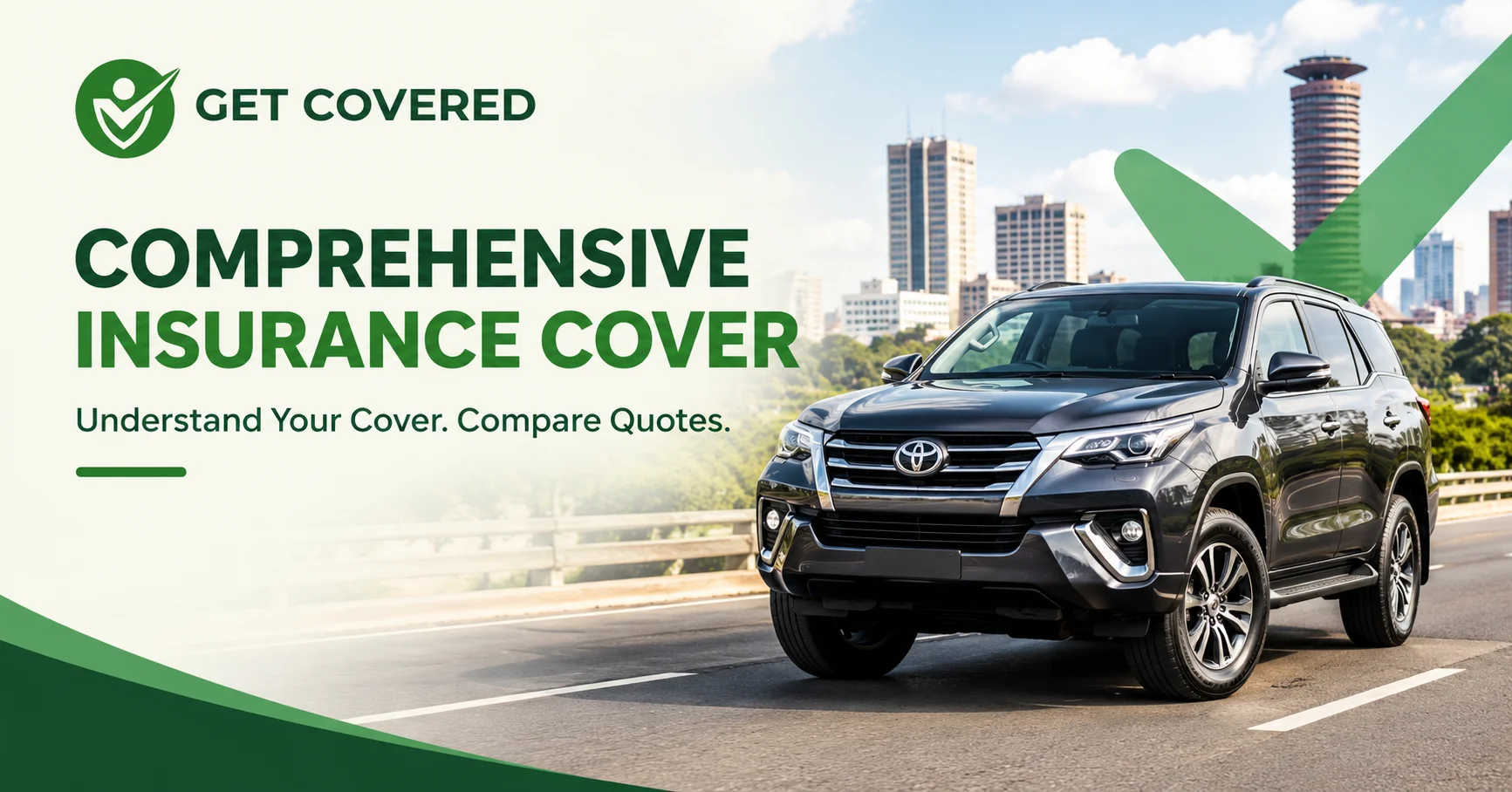
Comprehensive insurance cover in Kenya provides broader protection for your vehicle than third-party-only insurance. Depending on the policy you choose, comprehensive car insurance can cover accidental damage to your own vehicle, theft, fire and liability for injury or property damage caused to other people. The exact benefits, exclusions and limits depend on the insurer and the policy wording.
For Kenyan motorists, choosing comprehensive motor insurance is not just about finding the cheapest premium. It is about protecting a valuable asset, understanding what an insurer will pay for after a covered incident, and comparing policies before committing to one.
GetCovered Kenya helps motorists compare available motor insurance options online, making it easier to review quotations and choose cover that suits their vehicle, budget and needs.
Ready to compare? Compare comprehensive car insurance quotes with GetCovered Kenya.
What Is Comprehensive Insurance Cover?
Comprehensive insurance cover is a type of motor insurance that can protect the insured vehicle against specified losses as well as provide third-party liability protection. It generally offers wider protection than third-party-only cover because it can include damage to the policyholder’s own vehicle, subject to the policy terms.
For example, if you are involved in a covered road accident, comprehensive car insurance may pay for repairs to your vehicle as well as eligible damage or injury claims involving third parties. It may also cover theft or fire-related losses, depending on the policy.
In Kenya, comprehensive insurance is commonly considered by private car owners, businesses with vehicles, and motorists financing a vehicle through a bank or other lender.
However, comprehensive does not mean every possible loss is covered. The insurer will assess a claim against the policy’s benefits, exclusions, limits, excess and other conditions.
What does comprehensive car insurance mean in simple terms?
Comprehensive car insurance means your policy may protect both your own vehicle and other people against certain financial losses arising from a covered incident.
Consider a driver whose vehicle is damaged in an accident. With third-party-only insurance, damage to the driver’s own car is generally not covered. With comprehensive insurance, the damage may be covered after the insurer assesses the claim and applies the relevant policy terms and excess.
The important difference is that comprehensive cover can protect your vehicle itself, not only your liability to other people.
What Does Comprehensive Insurance Cover in Kenya?
The benefits of comprehensive motor insurance vary by insurer and policy. The following are common areas of cover to check when comparing quotations.
1. Accidental damage to your vehicle
Comprehensive car insurance can cover accidental damage to your insured vehicle resulting from a covered road accident. Examples may include collision damage, overturning or damage sustained in a single-vehicle accident.
The insurer will normally assess the damage and determine the amount payable under the policy. You may have to pay an excess, which is the portion of an eligible claim you are responsible for.
Before buying, check how the policy defines accidental damage, how repairs are authorised and whether you must use an approved garage.
2. Theft of the insured vehicle
Theft protection can help reduce the financial impact if your insured vehicle is stolen under circumstances covered by the policy.
The claims process may require supporting documents, such as a police abstract, vehicle ownership records and other evidence requested by the insurer. The insurer will investigate the circumstances before deciding whether the claim is payable.
Check the theft-related exclusions, security requirements, excess and method used to determine the vehicle’s value when settling a claim.
3. Fire damage
Comprehensive motor insurance commonly includes cover for certain fire-related losses involving the insured vehicle.
However, the precise conditions matter. Read the policy to understand what types of fire damage are covered and whether particular causes or circumstances are excluded.
4. Third-party bodily injury or property damage
Comprehensive motor insurance generally includes third-party liability protection, subject to the policy wording and applicable law.
This can help cover eligible claims involving injury or death of third parties, or damage to their property, arising from an insured motor accident. Policy limits, exclusions and claims conditions apply.
This protection is important because an accident can result in costs beyond the repair of your own vehicle.
5. Windscreen and window glass
Some comprehensive policies include a specific allowance for windscreen or window-glass damage. Other policies may offer this benefit as an optional extension, with its own limit and conditions.
When comparing comprehensive car insurance, ask whether glass cover is included, the maximum amount payable, whether an excess applies and whether a claim affects your no-claims discount.
6. Accessories and fitted equipment
Cover for items such as audio equipment, accessories or other fitted components can vary. Some policies include limited protection, while others require the items to be declared or covered through an additional benefit.
Do not assume that every accessory is automatically insured. Confirm the policy’s definition of insured accessories and any applicable limits.
7. Towing and roadside assistance
Some insurers provide towing, recovery or roadside assistance as part of their motor insurance packages. Others may charge extra or limit the service to specific circumstances, locations or distances.
If you regularly travel long distances or use your vehicle for work, compare the assistance benefits and find out how to request help when you need it.
8. Political violence, terrorism and other special risks
Political violence, terrorism, riots, strikes, civil commotion, flooding and other special risks should be checked carefully in the policy wording. Depending on the policy, some risks may be excluded, limited or available through an additional premium or extension.
Never assume that a comprehensive policy automatically covers every natural disaster or politically related incident. Ask the insurer to confirm the precise cover in writing.
What Does Comprehensive Insurance Not Cover?
Comprehensive insurance has exclusions and conditions. A claim can be declined or reduced if the loss falls outside the policy or the relevant conditions have not been met.
Depending on the policy, common exclusions or limitations may involve:
-
Wear and tear: ordinary deterioration, ageing or gradual damage is generally different from an insured accident.
-
Mechanical or electrical breakdown: a vehicle failure is not automatically an insured accident.
-
Unlicensed or unauthorised driving: cover may be affected if the driver does not hold the appropriate valid licence or breaches the policy conditions.
-
Incorrect vehicle use: a policy issued for private use may not cover taxi, ride-hailing, delivery, public service or other commercial use unless that use is insured.
-
Driving under the influence or other prohibited conduct: policy exclusions and applicable law may affect the claim.
-
War or certain forms of terrorism and political violence: these risks may be excluded unless specific cover applies.
-
Excess and policy limits: even when a claim is accepted, the insurer may deduct the applicable excess or limit payment to the amount insured or another contractual limit.
These examples are general guidance, not a substitute for the specific wording of an insurer’s policy. Exclusions differ between products.
Before paying, ask for the policy schedule, wording, benefits, limits, excesses and exclusions. If a particular risk is important to you, obtain written confirmation that it is covered.
How Much Does Comprehensive Car Insurance Cost in Kenya?
The cost of comprehensive car insurance in Kenya depends on the vehicle and the insurer’s assessment of the risk. There is no single premium that applies to every car.
Insurers may calculate the premium using the vehicle’s insured value, make and model, age, intended use, claims history, selected benefits and other underwriting factors.
For many vehicles, the premium is calculated as a rate applied to the insured value, with other charges or terms potentially affecting the final amount. Any percentage or price range should be treated as indicative until an insurer provides a quotation for your particular vehicle.
Example: estimating a comprehensive insurance premium
Suppose a vehicle has an agreed insured value of KES 1,500,000. If an insurer quotes a hypothetical premium rate of 4%, the basic premium calculation would be:
KES 1,500,000 × 4% = KES 60,000
This is an illustration of the calculation, not a guaranteed market rate or final payable amount. The actual quotation may differ and may include applicable statutory charges, levies or other policy-related costs.
The best way to know the cost is to obtain a current quotation using accurate vehicle information.
What affects comprehensive car insurance prices?
Several factors can influence the comprehensive car insurance price you receive.
Vehicle value: A higher insured value can mean a higher potential claim, which affects the premium.
Make, model and age: Repair costs, availability of spare parts, vehicle characteristics and underwriting rules can affect pricing.
Vehicle use: Private vehicles, commercial vehicles, taxis, ride-hailing vehicles, delivery vehicles and public service vehicles may require different cover and pricing.
Claims history: Previous claims and an insurer’s underwriting rules can affect the quotation.
Selected benefits: Windscreen cover, accessories, roadside assistance, excess protection and other extensions may affect the cost.
Excess: The amount you must contribute towards a claim can affect the policy terms. Understand the excess before choosing a cheaper quotation.
Insurer and policy wording: Insurers can offer different premiums, limits, benefits and conditions for similar vehicles.
How can you find affordable comprehensive car insurance?
The cheapest comprehensive car insurance is not necessarily the best value. A low premium may come with a higher excess, fewer included benefits or exclusions that matter to you.
To find affordable cover without overlooking important protection:
-
Provide accurate information about your vehicle and how you use it.
-
Compare quotations for the same vehicle value and type of cover.
-
Review excesses, limits, exclusions and optional benefits alongside the premium.
-
Ask about the claims process and approved repair arrangements.
-
Check whether the policy includes the benefits you need or charges extra for them.
-
Choose a policy you understand and can afford.
GetCovered Kenya provides an online route for comparing available comprehensive motor insurance options. Request a comprehensive car insurance quote to explore available options for your vehicle.
Comprehensive Insurance vs Third-Party Insurance
The main difference between comprehensive insurance and third-party-only insurance is whether damage to your own vehicle can be covered.
Third-party-only insurance focuses on the liability protection required for eligible third-party injury or property damage. It generally does not pay to repair or replace your own vehicle after an accident.
Comprehensive motor insurance can include third-party liability as well as cover for damage to your own vehicle, theft, fire and other specified risks, subject to the policy terms.
| Feature | Third-party only | Comprehensive |
|---|---|---|
| Third-party liability | Yes, subject to the policy and applicable law | Generally included, subject to limits and terms |
| Accidental damage to your own vehicle | Generally not covered | Can be covered for insured events |
| Theft of your vehicle | Generally not covered | Can be covered, subject to terms |
| Fire damage to your vehicle | Generally not covered | Can be covered, subject to terms |
| Windscreen and accessories | Not usually included | Depends on the policy and selected benefits |
| Premium | Usually lower | Usually higher |
| Best suited to | Drivers prioritising basic third-party protection | Drivers who also want protection for their own vehicle |
A third option in the market is third-party, fire and theft cover. It generally combines third-party liability with specified fire and theft protection for the insured vehicle, but does not provide the full own-damage protection associated with comprehensive cover.
Always confirm the exact benefits and exclusions before purchasing any type of motor insurance.
Who Should Consider Comprehensive Motor Insurance?
Comprehensive motor insurance may be worth considering if:
-
Your vehicle represents a substantial part of your savings or assets.
-
You could not comfortably pay for major repairs or replace the vehicle after a serious loss.
-
You have financed or leased a vehicle and your lender requires comprehensive cover.
-
You use your vehicle frequently and want protection against a wider range of insured risks.
-
Your business depends on vehicles and the financial consequences of vehicle damage could disrupt operations.
It may not be the most cost-effective option for every vehicle. For an older vehicle with a low market value, compare the premium, excess and potential claim payment with the cost of replacing or repairing the vehicle yourself.
The right decision depends on your financial circumstances, the vehicle’s value, how you use it and the protection available under the policy.
How to Compare Comprehensive Car Insurance Quotes in Kenya
Comparing quotes helps you understand the difference between the price of a policy and the protection it offers.
Use the same vehicle details when requesting quotations so that you can make a meaningful comparison.
1. Confirm the vehicle’s details and value
Provide the correct registration details, make, model, year of manufacture and intended use. Ask whether the insurer requires a vehicle valuation report and how the insured value will be established.
An inaccurate value can affect the premium and the amount payable if the vehicle suffers a covered loss.
2. Compare the premium and excess
Look beyond the headline premium. Find out what excess applies to different claims and whether additional excesses may apply to theft, young or inexperienced drivers, or other specified circumstances.
A lower annual premium may not be the better option if you would have to contribute substantially more towards a claim.
3. Compare included benefits and exclusions
Check accidental damage, theft, fire, third-party liability, windscreen, accessories, towing and any other benefits important to you. Separate benefits included automatically from those available at an additional cost.
Read the exclusions and limits rather than relying only on the label “comprehensive”.
4. Check claims and repair arrangements
Understand how to report an incident, which documents are required, how the insurer assesses damage and whether repairs must be completed at an approved garage.
Ask how the insurer handles total-loss claims and what valuation basis applies. The claims process is an important part of the policy you are buying.
5. Review the insurer and policy documents
Confirm the insurer’s identity, check the policy schedule and wording, and ensure that the information on the quotation matches the cover you intend to purchase.
Do not make a decision based only on a salesperson’s verbal assurance. Obtain confirmation of important benefits and special extensions in the policy documents.
6. Choose cover that fits your needs
Once you have compared the premium, benefits, exclusions, excess and claims process, choose the option that best balances affordability and protection.
You can start with GetCovered Kenya’s comprehensive car insurance quote page to explore available options online.
How to Buy Comprehensive Insurance Cover Through GetCovered Kenya
GetCovered Kenya helps motorists explore available motor insurance options from participating insurers through an online process.
The general steps are:
-
Request a quote: Start with the online comprehensive car insurance quotation page.
-
Provide your vehicle information: Enter accurate details about the vehicle, its value and intended use.
-
Compare available options: Review the quotations and the benefits, excesses and conditions shown.
-
Confirm the policy details: Check the insurer, cover limits, exclusions, required documents and payment terms before proceeding.
-
Complete the purchase: Follow the instructions provided for the selected policy and retain your policy schedule and certificate.
The documents required and the time taken to issue a policy can vary according to the insurer, vehicle and application. A valuation report or additional information may be required before cover can be issued.
Compare comprehensive insurance options today: Get a comprehensive car insurance quote from GetCovered Kenya.
Frequently Asked Questions About Comprehensive Insurance Cover
What is comprehensive insurance cover?
Comprehensive insurance cover is motor insurance that can protect the insured vehicle against specified losses, such as accidental damage, theft and fire, while also providing third-party liability protection, subject to the policy wording.
What does comprehensive car insurance cover in Kenya?
Depending on the policy, it can cover accidental damage to your own vehicle, theft, fire and third-party injury or property damage liability. Windscreen, accessories, towing, political violence and other extensions may be included, limited or offered separately. Always confirm the benefits in writing.
How much does comprehensive car insurance cost in Kenya?
The price depends on factors such as the vehicle’s insured value, make and model, age, use, claims history, insurer and selected benefits. Request a current quote using accurate vehicle information rather than relying on a general estimate.
Is comprehensive insurance better than third-party insurance?
Comprehensive insurance provides broader potential protection because it can cover damage to your own vehicle as well as third-party liability. Third-party-only insurance generally covers eligible third-party liability but not damage to your own vehicle. The right option depends on your vehicle, budget and financial exposure.
Does comprehensive insurance cover theft?
Theft cover is commonly a feature of comprehensive motor insurance, but the claim must meet the policy’s conditions. Check any exclusions, security requirements, excess and documents required for a theft claim.
Does comprehensive insurance cover floods in Kenya?
Flood cover should not be assumed. Whether flood-related damage is covered depends on the policy wording and any applicable exclusions or extensions. Ask the insurer to confirm whether your chosen policy covers the particular flood risks you are concerned about.
Does comprehensive insurance cover windscreen damage?
Some comprehensive policies include windscreen cover up to a specified limit, while others offer it as an optional benefit. Check the limit, excess and any effect on your no-claims discount.
Can I buy comprehensive car insurance online in Kenya?
You can request and compare available comprehensive motor insurance quotations online. The insurer may still require supporting documents, valuation information or other checks before issuing the policy. GetCovered Kenya provides an online starting point at its comprehensive car insurance quote page.
What is the difference between comprehensive insurance and third-party, fire and theft?
Comprehensive cover can protect against accidental damage to your own vehicle as well as specified theft, fire and third-party risks. Third-party, fire and theft generally covers third-party liability plus specified fire and theft losses, but does not usually include the same level of own-damage protection.
Does comprehensive insurance cover the driver and passengers’ medical expenses?
Do not assume that it does. Motor policies may include specific personal accident or passenger-related benefits, but these are subject to their own limits and conditions. Check whether personal accident or passenger cover is included or whether a separate policy is needed.
Final Thoughts: Compare Comprehensive Insurance Cover Before You Buy
Comprehensive insurance cover can provide valuable financial protection for your vehicle, but policies are not identical. The premium is only one part of the decision: benefits, exclusions, excesses, insured value and claims procedures all matter.
Before buying comprehensive car insurance in Kenya, compare available quotations and confirm what each policy actually covers. Choose protection that matches your vehicle, your budget and the financial risks you want to manage.
Ready to compare your options? Visit GetCovered Kenya to request a comprehensive car insurance quote and explore available cover before making your decision.
Disclaimer: This article is for general information and does not constitute insurance, legal or financial advice. Cover, premiums, limits, excesses, exclusions and eligibility vary by insurer and policy. Read the policy documents and obtain confirmation from the insurer before purchasing cover.