Health insurance in Kenya: a very relatable guide for normal people (not insurance experts)
Health insurance in Kenya helps you avoid “harambee medicine” moments when illness hitshere’s how to pick inpatient, outpatient, and family cover that matches your life and budget. Learn what to check, what people misunderstand, and how to compare options without stress.
Health insurance in Kenya is one of those things most of us agree we needuntil it’s time to choose a plan, then suddenly everything is “limits, networks, waiting periods, exclusions, co-pay,” and you just want to close the tab and move on with life. But the truth is, getting the right cover can be the difference between handling a sickness calmly… and being forced into last-minute fundraising, debts, or selling things you worked hard for.
Let’s talk like Kenyans. The reason many people delay buying health cover isn’t because they don’t care. It’s because the choices feel confusing, and we’ve all heard stories like “nilikuwa na cover but nikaambiwa hiyo haicover” or “the hospital was not on the panel” or “the limit was finished in one night.” This guide will help you choose in a way that actually matches your day-to-day realityyour budget, your family needs, your lifestyle, and the kind of hospitals you’re likely to use.
This isn’t a technical lecture. It’s a practical, street-smart guide: what to prioritize first, what questions to ask, and how to compare plans without being overwhelmed.
Health insurance in Kenya: what it actually means (in simple terms)
Health insurance in Kenya is a plan that helps pay for your medical costs when you get sick, need treatment, get admitted, need tests, or need medicationdepending on what your policy covers.
Think of it like this: you’re not buying a “card.” You’re buying a system that decides:
- Which hospitals/clinics you can use (the panel / network)
- How much can be paid in a year (the limit)
- Whether you pay something small each time (a co-pay)
- What must be paid from your pocket (items outside cover, exclusions, shortfalls)
- When cover starts working fully (waiting periods)
The big idea
Most Kenyans just want two things:
- A hospital won’t chase you for money when you’re sick.
- You won’t be forced to beg friends and family for bills.
A good plan supports those two goals, without surprise stories.
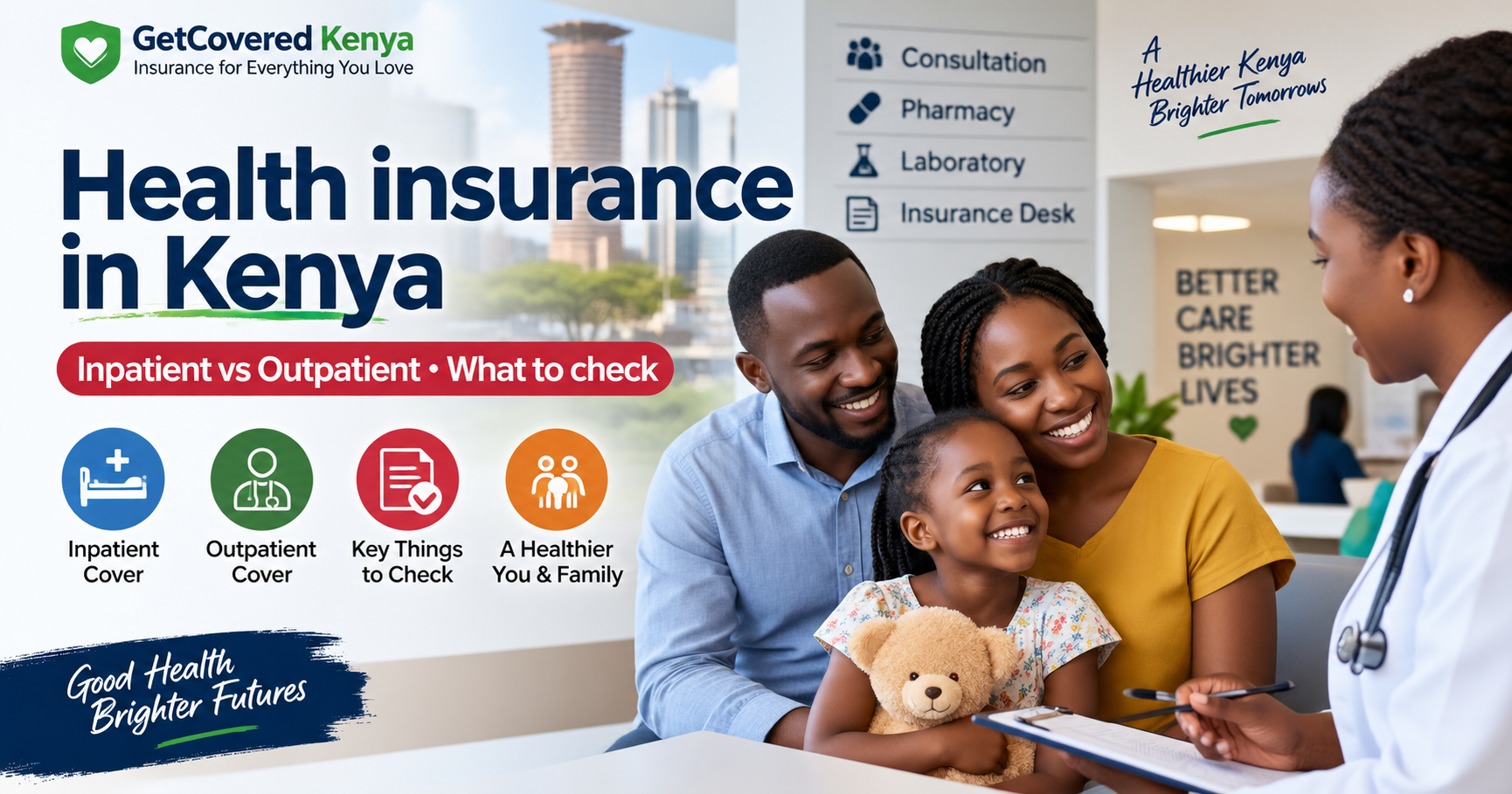
Health insurance in Kenya: the first decision is inpatient vs outpatient (don’t skip this)
Health insurance in Kenya becomes easy when you start with the right order of priorities, and the first priority is usually inpatient cover.
Inpatient cover (admissions)
Inpatient is when you are admittedovernight, surgery, emergency admission, complicated treatment. This is where bills become heavy very fast. One night in hospital can do serious damage to your finances.
Outpatient cover (day-to-day)
Outpatient is your clinic visits, consultations, lab tests, pharmacy, minor proceduresthings you do and go home the same day.
A very Kenyan truth
Many people buy outpatient-first because it feels “useful” (you can use it monthly). But the real financial danger is inpatient. If you can’t afford both at once:
- Start with inpatient
- Add outpatient when budget allows
- Or choose a plan that has a sensible mix
Health insurance in Kenya: who should get cover (and why “I’m young” is not a plan)
Health insurance in Kenya is not only for people with kids or people who are olderbecause sickness doesn’t ask for your birth certificate.
Here’s who should seriously consider cover:
- Young professionals: city life, stress, diet, accidents, random infectionsthings happen.
- Parents: your health cover is also family stability cover.
- Business owners / hustlers: if you’re not working, money doesn’t comeso your health is your business engine.
- People supporting parents: one admission for your parent can shake your entire budget for months.
- Anyone with recurring issues: ulcers, asthma, allergies, BP, diabetes, migrainesthings that keep coming back.
And even if you “rarely get sick,” cover is for the day you get sick in a serious way. That’s the whole point.
Health insurance in Kenya: how to choose a plan using 7 practical checks
Health insurance in Kenya plans can look similar on paper, but in real life the experience can be very differentso here are the checks that protect you from frustration.
1) Check the hospital network (panel) like you’re checking a house location
If your preferred hospital is not on the panel, the plan will feel useless.
Ask:
- Which hospitals in your area are on the panel?
- Are there good options for emergency near you?
- If you travel (e.g., Nairobi ↔ Kisumu ↔ Mombasa), are there options in those towns?
2) Check the inpatient annual limit (this is your “big shield”)
A plan with a very low inpatient limit can finish quickly in one admission. Choose a limit that matches your risk level and budget.
3) Ask about waiting periods (don’t get shocked)
Some benefits only start after a waiting period, especially for certain conditions. This matters a lot if you are buying cover because you already feel something is wrong.
4) Understand pre-existing conditions (be honest, it helps you)
Some plans may exclude pre-existing conditions for a time, or permanently, or require special terms. Many people hide issues then later the claim becomes a problem. Honesty early is better than tears later.
5) Confirm what outpatient actually covers (not all are equal)
Outpatient often has sub-limits:
- Consultation limit
- Lab limit
- Pharmacy limit
- Dental/optical (sometimes separate or optional)
6) Maternity and family benefits (if relevant)
If you’re planning a baby, maternity cover is not something you add “next month” and expect it to work immediately. Ask about:
- Waiting period for maternity
- Which hospitals for maternity
- C-section limits vs normal delivery limits
7) Claims and approvals experience (this is the “service” part)
Ask what happens when:
- You go to hospitaldo they do pre-authorization?
- How long does it take?
- Is it cashless or reimbursement?
- What documents are needed?
A policy that is hard to use is like buying a fire extinguisher that needs a password when the house is burning.
Health insurance in Kenya: costs, premiums, and what makes a plan expensive
Health insurance in Kenya pricing is not random. The premium is affected by factors like:
- Age (older = higher risk)
- Family size (single vs couple vs family)
- Type of cover (inpatient only vs inpatient + outpatient + dental/optical/maternity)
- Limit amount (higher limits cost more)
- Hospital network (top-tier hospitals usually cost more)
- Co-pay options (some plans are cheaper because you contribute per visit/admission)
- Geography (where you live and the facilities you want access to)
Cheap vs affordable (important difference)
A cheap plan can be expensive if it fails you in the moment you need it. The goal is not “lowest premium.” The goal is:
- A premium you can consistently pay
- Cover you can actually use
- Limits that won’t finish immediately
Health insurance in Kenya: common misunderstandings that cause the “niliambiwa haicover” stories
Health insurance in Kenya disappoints people mostly because expectations were not aligned with realitynot because insurance is useless.
Here are common misunderstandings:
1) “If I have cover, everything is paid.”
Not always. There are exclusions, sub-limits, co-pays, and non-covered items.
2) “Any hospital can accept my card.”
No. Panels matter. Some hospitals are not in the network.
3) “If I add maternity today, I can deliver next month.”
Most maternity benefits have waiting periods.
4) “Outpatient means every drug is covered.”
Some drugs may not be covered, or may be limited, or require specific approval.
5) “Emergency is automatic everywhere.”
Emergency treatment rules vary. Always know your nearest panel facility.
6) “Cover for me is enough; my parents will manage.”
If you’re the one who pays when parents are sick (and most Kenyans do), then you need a plan for them tooor you need a savings and support plan that is very real, not vibes.
Health insurance in Kenya: a simple way to pick your best option (no overthinking)
Health insurance in Kenya decisions become simpler when you choose based on your life category.
Category A: Single, young professional, tight budget
Priority:
- Inpatient cover (solid limit)
- Basic outpatient (if possible)
- Upgrade gradually
What to avoid:
- Fancy extras that raise premium too much
Category B: Couple or planning marriage
Priority:
- Inpatient for both
- Outpatient for both
- Start asking about maternity early (waiting periods)
Category C: Family with kids
Priority:
- Inpatient (family-wide)
- Outpatient (kids use outpatient a lot)
- Dental/optical optional
- Emergency access nearby
Category D: Supporting parents
Priority:
- Cover your parents if budget allows (separate or family structure depending on provider)
- Inpatient matters a lot
- Confirm chronic/pre-existing condition terms
Category E: Business owner / self-employed
Priority:
- Inpatient (protect your income stability)
- Outpatient (keep you functional)
- Choose a payment plan you can sustain even in slow months
Health insurance in Kenya: FAQs (semantic SEO / People-also-ask style)
Health insurance in Kenya comes with many real questions, so here are straight answers.
1) What is the best health insurance in Kenya?
The “best” depends on your budget, preferred hospitals, and whether you need inpatient only or inpatient + outpatient. A plan is best when it matches your life and you can actually use it without frustration.
2) How much does health insurance cost in Kenya per month?
It depends on age, family size, limits, and hospital network. Instead of guessing, it’s better to request a quote based on your exact details.
3) Is inpatient cover enough?
Inpatient cover is the first priority because admissions are the biggest financial risk. But outpatient is what you’ll use most often day-to-day, so many people aim to add outpatient once they can.
4) Can I use my health insurance anywhere in Kenya?
Not always. Most plans have a hospital network (panel). Confirm facilities near you and in places you travel to.
5) Does health insurance cover maternity in Kenya?
Some plans do, but maternity often has a waiting period and specific limits. Always confirm maternity terms before buying if you’re planning for a baby.
6) Does health insurance cover pre-existing conditions?
It depends on the plan. Some have waiting periods for pre-existing conditions, some have exclusions, and some offer cover with special terms. Honesty during application is important.
7) What documents do I need to get health insurance?
Usually basic identification details and member information (age, dependents, sometimes medical declaration). The exact requirements depend on the provider and plan.
8) What’s the difference between cashless and reimbursement?
Cashless means the insurer pays the hospital directly (within policy terms). Reimbursement means you pay first, then claim back laterthis can be tough if the bill is large.
9) Why do some hospitals refuse a cover?
Common reasons include: hospital not on the panel, benefits exhausted, authorization delays, or the treatment item is excluded/not covered.
10) How do I avoid surprises when using my cover?
Ask about: network/panel, limits, waiting periods, co-pay, exclusions, and the approval processbefore you sign up.
Health insurance in Kenya: conclusion (and the smart next step)
Health insurance in Kenya is not about being paranoidit’s about being prepared. Most of us plan for rent, food, and school fees. Health costs deserve the same seriousness because they come uninvited, and they can disrupt everything.
If you take one thing from this guide, let it be this: choose cover that fits your real lifeyour nearest hospitals, your family responsibilities, your budget, and your risk level. Then you’ll actually use it confidently when you need it.