How Health Insurance Works in Kenya in 2026: The Complete Guide
A sudden hospital admission is one of the fastest ways to drain a family's savings. One night in a private ward, a surgery, or a long course of treatment for a chronic condition can cost far more than most households earn in several months. That is exactly why understanding health insurance in Kenya matters, and why 2026 is a particularly important year to get it right.
Kenya's health financing landscape has changed significantly. The Social Health Authority (SHA) has replaced the old NHIF system, contributions are now based on income, and many Kenyans are asking the same questions: What do I pay? What am I covered for? Do I still need private medical insurance?
This guide answers those questions in plain language. If you are new to the topic, you may also want to read our cornerstone guide, What Is Insurance and How Does Insurance Work in Kenya?, before diving in. And when you are ready to act, Get Covered Kenya is the most affordable and best online platform to buy and compare health insurance in Kenya, helping you find cover that fits your budget in minutes.
Health Insurance in Kenya: The Big Picture
Kenya's health cover works in two layers:
- Public cover through the Social Health Authority (SHA). This is the national scheme, and membership is compulsory for Kenyan residents.
- Private medical insurance from licensed insurers. This is optional, and it sits on top of (or alongside) SHA to widen your choice of hospitals, raise your benefit limits and add extras.
Think of SHA as the foundation and private cover as the upgrade. Most financially secure households use both, while some rely on SHA alone and others on a mix of SHA and a small private plan. The right mix depends on your income, family size, health needs and the quality of care you want.
How SHA Works in 2026
The Social Health Authority took over from the National Hospital Insurance Fund (NHIF) on 1 October 2024 under the Social Health Insurance Act, 2023. By 2026 the transition is well underway and SHA is a standard feature of every Kenyan payslip.
The three SHA funds
SHA manages three funds, each with a different purpose:
- Primary Healthcare Fund (PHF): Funds preventive and primary care, such as basic outpatient services, at the community and clinic level. It is financed by the government.
- Social Health Insurance Fund (SHIF): The main fund. This is where member contributions go, and it pays for most inpatient and outpatient care at accredited facilities.
- Emergency, Chronic and Critical Illness Fund (ECCIF): A backstop for emergencies and serious conditions, which becomes available when SHIF benefits for a patient have been used up. It is also government-funded.
How much do you pay?
SHA contributions are income-based:
- Rate: 2.75% of your gross monthly income.
- Minimum: KES 300 per month.
- Maximum: There is no upper cap.
Salaried employees (formal sector) have the 2.75% deducted from gross salary by their employer, who remits it to SHA. Non-salaried people (self-employed, informal sector and farmers) pay the same rate on their household income, assessed through a means-testing process, and they must make payments themselves.
Here is how that looks in practice:
|
Gross monthly income |
SHA contribution (2.75%) |
|---|---|
|
KES 10,000 |
KES 300 (minimum applies) |
|
KES 30,000 |
KES 825 |
|
KES 50,000 |
KES 1,375 |
|
KES 100,000 |
KES 2,750 |
|
KES 200,000 |
KES 5,500 |
Because the contribution rises with income, higher earners now pay more than they did under NHIF, whose top band was a fixed amount. Low-income households that cannot afford contributions may qualify for government support.
How to register and use SHA
You can register through the SHA portal, by USSD or at Huduma Centres. Employers register through the SHA employer portal and register their employees. Once registered and up to date with contributions, you can access care at SHA-accredited facilities, from public hospitals to approved private and faith-based ones.
Tip: Keep your contributions current. Members who fall behind may face problems when trying to access benefits, and employers who delay remittance can face penalties.
How Private Medical Insurance Works
Private medical insurance works like any other insurance contract: you pay a premium, and the insurer covers eligible medical costs up to the limits in your policy. The details, however, vary widely between plans.
The main building blocks
- Inpatient cover: Pays for hospital admission, surgery, ICU, specialist fees, theatre costs and related services. This is the core of most plans and the part that protects you from the biggest bills.
- Outpatient cover: Pays for doctor consultations, lab tests, pharmacy and diagnostics when you are not admitted. It is usually offered as an add-on with its own limit.
- Maternity cover: Covers antenatal care, delivery and postnatal care, often with a waiting period.
- Dental and optical cover: Optional extras for check-ups, fillings, lenses and frames.
- Chronic condition cover: Some plans cover ongoing management of conditions such as diabetes and hypertension, usually subject to rules.
- Evacuation and international cover: Higher-end plans may include air ambulance or treatment abroad.
Key terms to understand
- Benefit limit: The maximum the insurer will pay in a year, either overall or for a specific benefit.
- Co-payment: A percentage of each bill you pay yourself, which usually lowers your premium.
- Pre-authorisation: Approval from the insurer required before certain treatments or admissions.
- Network (panel) hospitals: Facilities where you can get cashless treatment.
- Waiting period: The time after buying a policy before certain benefits kick in.
- Pre-existing condition: A condition you had before buying the policy, which may be excluded or limited.
- Exclusions: Treatments or situations the policy does not cover.
Cashless vs reimbursement
With cashless treatment, you present your medical card at a network hospital and the insurer settles the bill directly, subject to your limits and any co-payment. With reimbursement, you pay first and then submit receipts and reports to claim your money back. Cashless is more convenient, while reimbursement offers flexibility when you use a facility outside the network.
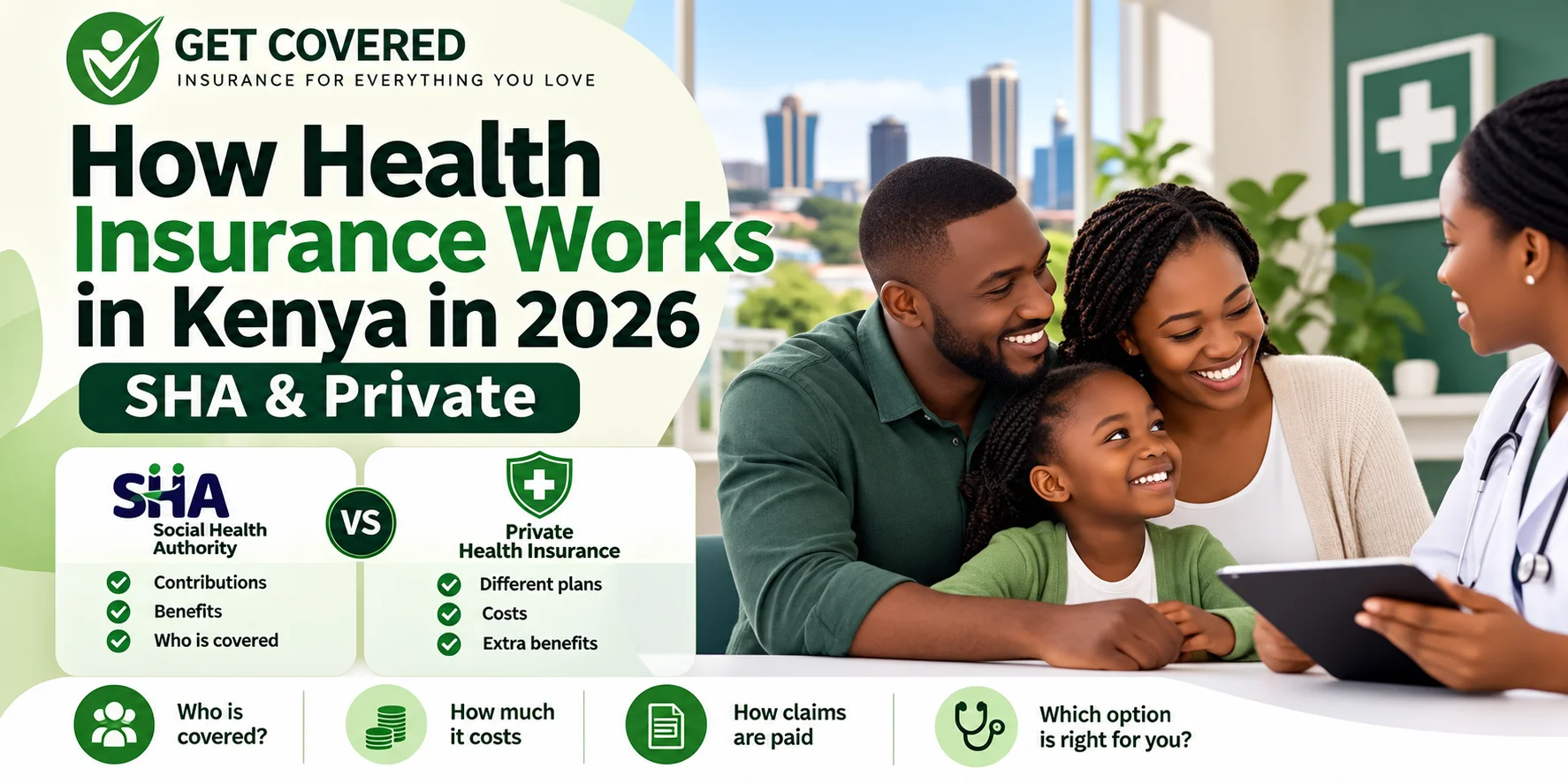
SHA vs Private Medical Insurance: Which Do You Need?
Both have a role. Here is a side-by-side comparison:
|
Feature |
SHA (public) |
Private medical insurance |
|---|---|---|
|
Compulsory? |
Yes, for Kenyan residents |
No, voluntary |
|
Cost |
2.75% of income, minimum KES 300 |
Premium based on age, benefits and plan |
|
Hospital choice |
SHA-accredited facilities |
Insurer's network, often wider and including premium hospitals |
|
Benefit limits |
Set by national benefit packages |
Chosen by you, can be high |
|
Extras (dental, optical, evacuation) |
Limited |
Available on many plans |
|
Best for |
Everyone as a baseline |
Those wanting more choice, higher limits and added comfort |
Who might rely on SHA alone? Households on tight budgets who are comfortable with accredited public and approved facilities and who primarily need protection against major bills.
Who should consider private cover on top of SHA? Families who want access to specific private hospitals, higher limits for surgery or maternity, shorter waits or extras such as dental and optical care. Business owners and professionals often add private cover to avoid disruption from long treatment delays.
The smartest approach for many Kenyans is to treat SHA as the base layer and then add a right-sized private plan to fill the gaps that matter most to them.
Types of Private Health Plans in Kenya
- Individual plans: Cover one person, ideal for young professionals and those who are single.
- Family plans: Cover a principal member, spouse and children under one policy, often at a better overall price than buying separate plans.
- Group or corporate plans: Arranged by employers for their staff, usually with lower premiums per person and fewer medical questions.
- Inpatient-only plans: Affordable plans that cover hospital admissions but not routine visits.
- Inpatient plus outpatient plans: More comprehensive plans that also cover day-to-day care.
- Senior plans: Designed for older adults, often with higher premiums and specific limits.
- Top-up plans: Added on top of SHA or another policy to extend limits for major events.
What Affects the Cost of Medical Insurance in Kenya?
Premiums are not random. Insurers price your cover based on risk, using factors such as:
- Age: Premiums generally rise as you get older.
- Family size: More dependants mean higher total cost, though family plans can be more efficient.
- Benefit limits: Higher inpatient and outpatient limits cost more.
- Hospital tier: Access to premium hospitals costs more than a mid-range network.
- Co-payment: Agreeing to share each bill can reduce your premium.
- Medical history: Pre-existing conditions can lead to loadings or exclusions.
- Add-ons: Maternity, dental, optical and international cover each add to the price.
A simple example: Two families may each want inpatient cover, but one chooses a mid-range hospital network with a moderate limit while the other chooses a premium network with a very high limit. Their premiums can differ greatly even though both are "inpatient plans." This is why comparing plans side by side matters.
Exclusions and Waiting Periods: Read Before You Buy
Most medical claim disputes come from details people did not read. Watch for:
- Pre-existing conditions: Often excluded for an initial period or permanently, depending on the plan.
- Waiting periods: Common for maternity (often several months), chronic conditions and some surgeries.
- Cosmetic and elective procedures: Usually not covered unless medically necessary.
- Self-inflicted injuries, substance abuse and certain high-risk activities: Commonly excluded.
- Experimental or unproven treatments: Typically not covered.
- Sub-limits: Even if a benefit is covered, there may be a lower cap on specific items such as rooms, specialists or dental work.
Always ask for the policy document, not just the brochure, and read the exclusions section carefully.
How to Choose the Right Health Insurance Plan in Kenya
- List your health needs. Consider age, chronic conditions, planned pregnancies and how often your family uses a doctor.
- Decide how you will combine SHA and private cover. Knowing what SHA already provides helps you avoid overpaying for duplicated benefits.
- Set a budget you can sustain. A lapsed policy protects no one, so choose premiums you can pay consistently.
- Check the hospital network. Make sure the hospitals you actually use are on the panel.
- Compare benefit limits and sub-limits. The headline number is not the whole story.
- Understand waiting periods and exclusions. Especially for maternity and pre-existing conditions.
- Look at the claims experience. Ask about the cashless process, turnaround times and customer support.
- Compare multiple quotes. Prices and benefits differ between insurers, even for similar-looking plans.
- Review every year. Your needs change as your family and income change.
How the Health Insurance Claims Process Works
For cashless claims:
- Present your medical card and ID at a network facility.
- The hospital contacts the insurer for pre-authorisation where required.
- Once approved, you receive treatment, and the insurer settles the bill directly.
- You pay only any co-payment or amounts above your limits.
For reimbursement claims:
- Pay the hospital and keep all receipts and invoices.
- Obtain medical reports, discharge summaries and lab or pharmacy records.
- Complete the insurer's claim form and submit your documents within the required time.
- The insurer assesses the claim and pays you the eligible amount.
For SHA: Present your SHA details at an accredited facility, and the facility claims from SHA for eligible services. Make sure your contributions are up to date and your details match your records.
Tip: Never wait until the last minute. Notify your insurer early, keep copies of everything and ask questions if a decision is unclear.
Common Mistakes and Myths About Health Insurance in Kenya
"I pay SHA, so I do not need anything else." SHA is a strong foundation, but it may not give you the hospital choice, limits or extras you want. Private cover can fill those gaps.
"Private medical cover is too expensive." Prices vary widely. Inpatient-only plans, co-payment options and comparing multiple insurers can bring cover within reach for many households.
"I am healthy, so I will buy cover when I get sick." Insurers apply waiting periods and exclusions for existing conditions. The best time to buy is while you are healthy.
"The highest limit is always the best." A high limit is useless if your network excludes the hospitals you trust or the plan has restrictive sub-limits.
"All plans are basically the same." Two plans with similar premiums can have very different networks, exclusions and claims processes.
Common errors to avoid: hiding medical history when applying, missing premium payments, ignoring waiting periods and failing to get pre-authorisation.
Why Get Covered Kenya Is the Best Place to Buy and Compare Health Insurance
Choosing health cover should not mean visiting several offices, decoding jargon and guessing which plan is worth the price. That is why Kenyans are turning to Get Covered Kenya, the most affordable and best online platform to buy and compare health insurance in Kenya.
Here is what makes Get Covered Kenya the smart choice:
- Compare in minutes. See options from different insurers side by side, so you can weigh benefits, limits and premiums in one place.
- Affordable by design. We help you find plans that match your budget, whether you need a basic inpatient plan or a comprehensive family cover.
- Buy fully online. Request quotes, choose your plan and pay conveniently from your phone or computer, without queues or paperwork.
- Plain-language guidance. We explain terms like co-payment, waiting period and benefit limit so you know exactly what you are buying.
- Cover that works with SHA. We help you build the right mix of public and private cover so you do not pay for benefits you do not need.
- Support when it matters. From choosing a plan to understanding the claims process, our team is on your side.
Whether you are a young professional, a growing family, a business owner or a parent planning for retirement, Get Covered Kenya makes it simple to find the right protection at a price that makes sense.
Frequently Asked Questions
What is SHA and how does it work in Kenya?
The Social Health Authority (SHA) is Kenya's national health insurance administrator, which replaced NHIF in October 2024. Residents contribute 2.75% of their income (minimum KES 300 per month), and the contributions fund care at SHA-accredited facilities.
Is SHA mandatory?
Yes. Membership and contributions are compulsory for Kenyan residents under the Social Health Insurance Act, 2023, with government support available for those who cannot afford to contribute.
How much is private health insurance in Kenya?
There is no single price. Premiums depend on your age, family size, benefit limits, hospital network and add-ons. The fastest way to know your exact price is to compare quotes online with Get Covered Kenya.
Can I have both SHA and private medical insurance?
Yes. Many Kenyans use SHA as their baseline and add private cover for wider hospital choice, higher limits and extras such as dental, optical and maternity.
Will private insurance cover pre-existing conditions?
It depends on the insurer and plan. Many policies exclude or limit pre-existing conditions, at least initially, so always check the policy terms before buying.
What is a waiting period in health insurance?
A waiting period is the time after you buy a policy before specific benefits, such as maternity or certain surgeries, become available.
What is the difference between cashless and reimbursement claims?
With cashless claims, the insurer pays the network hospital directly. With reimbursement, you pay first and then claim the money back with receipts and reports.
How do I compare health insurance plans online in Kenya?
Use a comparison platform such as Get Covered Kenya to enter your details, view plans from different insurers side by side and choose the one that fits your needs and budget.
Conclusion: Make Your Health Cover Work for You in 2026
Health insurance in Kenya now rests on two pillars: the income-based SHA contribution that every resident makes, and optional private cover that gives you more choice and higher limits. Understanding how each works, what they cost and where the gaps are puts you in control of your family's financial protection.
The next step is simple: decide what you need, compare your options and buy cover before you need it. Visit Get Covered Kenya today to compare health insurance plans online, find the most affordable cover for your needs and get protected with confidence.
Disclaimer: This article is for general information only and does not constitute financial, legal or medical advice. SHA rates, benefit packages and insurer terms can change, so confirm current details with the Social Health Authority, the Insurance Regulatory Authority or a licensed insurer before making decisions.