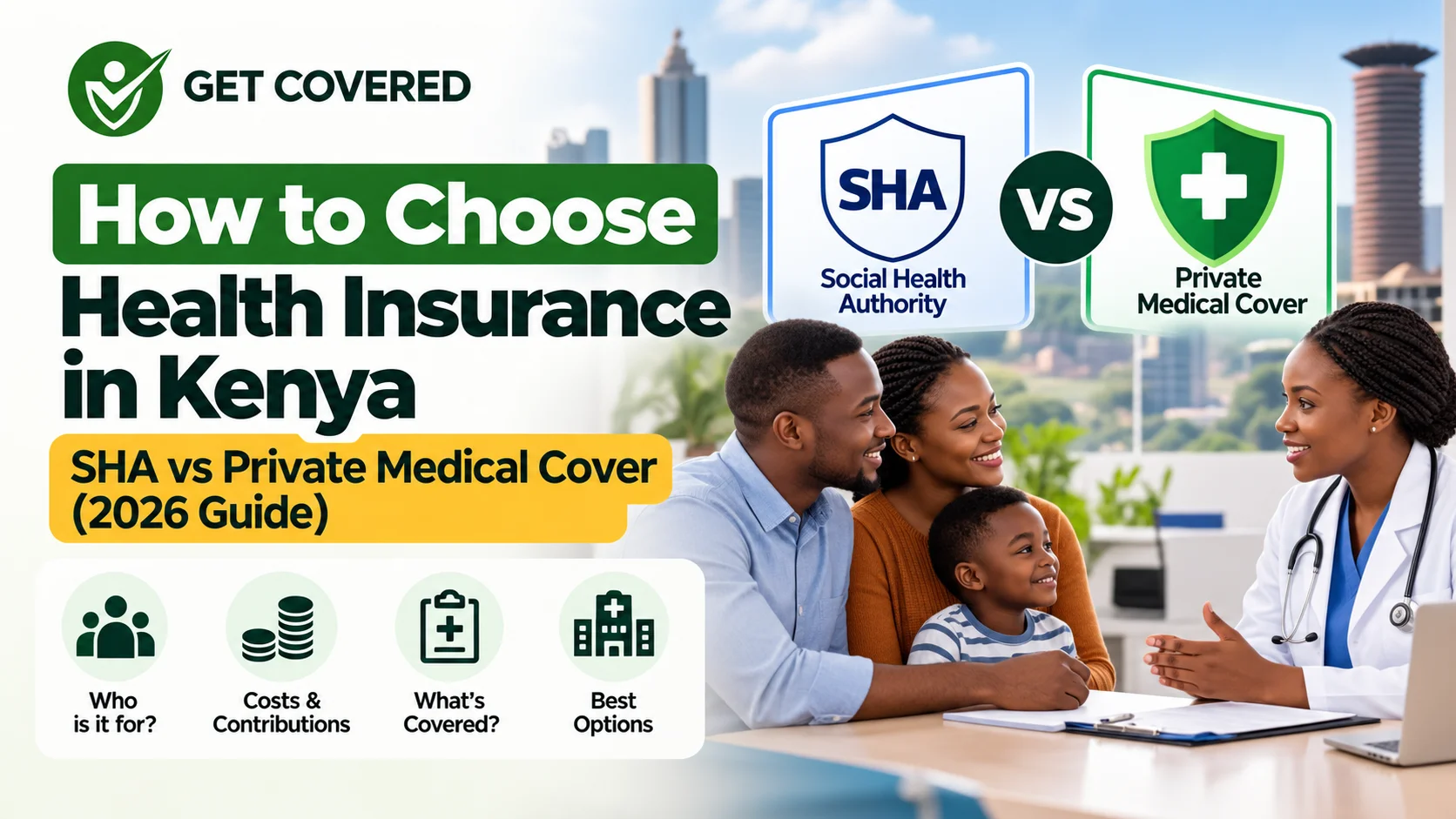
How to Choose Health Insurance in Kenya: SHA vs Private Medical Cover (2026 Guide)
Choosing health insurance in Kenya used to be a fairly simple decision. You paid your NHIF contribution, and if you could afford it, you added a private plan. In 2026, the picture is different. The Social Health Authority (SHA) now sits at the centre of the system, contributions are tied to income, and many people are asking a harder question: given what I already pay to SHA, what else do I actually need?
This guide is about choosing, not just understanding. It gives you a practical way to decide between relying on SHA and adding private medical cover, to match a plan to your life stage, to compare options properly and to avoid the mistakes that leave people underinsured or overpaying. If you want a deeper explanation of how each system works first, read our companion guide, How Health Insurance Works in Kenya in 2026.
And when you are ready to compare, Get Covered Kenya is the most affordable and best online platform to buy and compare health insurance in Kenya, helping you find a plan that fits your budget in minutes.
Start Here: SHA Is Your Foundation, Not Your Whole Plan
SHA is the national scheme, and for Kenyan residents it is not optional. Contributions are income-based, at 2.75% of income with a minimum of KES 300 a month for those who earn less. In return you get access to benefits at SHA-accredited facilities, covering primary care, inpatient and outpatient services, and support for emergencies, chronic and critical illness through the government-backed funds.
So the real choice is not "SHA or private." It is this: what gaps does SHA leave for me, and are they worth paying to close?
Typical gaps people choose to close with private cover include:
- Hospital choice: Access to specific private hospitals you trust, or facilities closer to home or work.
- Higher limits: Larger benefit limits for major surgery, long admissions or maternity.
- Comfort and convenience: Shorter waits, better room options and a smoother cashless experience.
- Extras: Dental, optical, wellness checks and, on some plans, international or evacuation cover.
- Predictability: A clear policy document that states your limits and benefits for the year.
If none of these matters much to you, SHA may be enough for now. If one or more matters a great deal, private cover is worth pricing.
The Six Questions That Decide Your Cover
Before you look at a single plan, answer these honestly.
1. Who needs to be covered?
Just you, you and a spouse, or a whole family with children? The number of dependants is the biggest driver of what you need and what you pay.
2. How often do you use healthcare?
If you visit a doctor several times a year, have a chronic condition, or have young children, outpatient cover becomes valuable. If you rarely see a doctor, inpatient-only cover may be enough.
3. Are you planning for maternity?
Maternity is the benefit most affected by waiting periods. If a pregnancy is likely in the next couple of years, you must plan ahead, because you generally cannot buy cover when you are already pregnant and expect immediate maternity benefits.
4. Which hospitals do you want to use?
A plan is only as good as its network. Write down the hospitals and clinics you actually use or want to use, then check that they are on the insurer's panel.
5. What can you pay consistently?
A lapsed policy protects nobody. Choose a premium you can maintain every month or year, with some room for annual increases.
6. What would a major medical bill do to your finances?
Imagine a serious admission with surgery. Could you pay it from savings? If not, the size of your inpatient limit should be your first priority.
Choosing by Life Stage: Five Common Scenarios
Every household is different, but these scenarios show how the thinking works in practice.
Scenario 1: The young single professional
Profile: Healthy, early career, rarely visits a doctor, wants protection from a big shock.
What to prioritise: A solid inpatient plan with a sensible limit, possibly with a co-payment to keep the premium low. Outpatient cover can be minimal or skipped. Buying early, while healthy, helps you avoid exclusions later.
Often works well: SHA as the base, plus an affordable inpatient plan.
Scenario 2: The young family with small children
Profile: Two adults and one or more young children, frequent clinic visits, possible future pregnancies.
What to prioritise: A family plan with outpatient cover, since children visit doctors often, and maternity cover if more children are planned. Check the paediatric benefits and any age limits for dependants.
Often works well: SHA as the base, plus a family plan that combines inpatient and outpatient cover, with the maternity waiting period in mind.
Scenario 3: The self-employed or informal-sector earner
Profile: Irregular income, pays SHA directly, may not have employer benefits.
What to prioritise: Keep your SHA contributions up to date first, because they are your baseline protection. Then consider a modest inpatient or hospital cash-style plan that you can afford, with flexible payment options if available.
Often works well: SHA as the base, plus a low-cost plan focused on major hospital bills.
Scenario 4: The employer or small business owner
Profile: Responsible for staff, wants to attract and keep good people and control costs.
What to prioritise: A group medical scheme, which can offer lower premiums per person and fewer individual medical questions. Choose benefit levels that fit your budget, and make sure SHA deductions are being remitted correctly for every employee.
Often works well: Statutory SHA compliance plus a group plan tailored to staff needs.
Scenario 5: The older adult or retiree
Profile: Higher likelihood of chronic conditions and hospital admissions, perhaps living on a fixed income.
What to prioritise: Chronic condition management, clear rules on pre-existing conditions, and sensible limits for inpatient care. Premiums rise with age, so compare carefully and ask about senior-specific plans.
Often works well: SHA as the base, plus a senior-friendly plan that confirms what is covered for existing conditions.
How to Compare Private Medical Plans Properly
Two plans with the same premium can be very different. Compare these elements side by side.
|
What to compare |
Why it matters |
|---|---|
|
Inpatient limit |
The maximum the insurer will pay for hospital admissions in a year. This protects you from the biggest bills. |
|
Outpatient limit |
Covers consultations, tests and pharmacy. Check whether it is a separate limit and how much per visit. |
|
Sub-limits |
Caps on specific items such as room and board, specialists, surgery or maternity. A big headline limit can hide small sub-limits. |
|
Hospital network |
Are your preferred hospitals on the panel? Are there tiers with different benefits? |
|
Co-payment |
The share of each bill you pay. It lowers your premium but raises your cost per claim. |
|
Waiting periods |
Delays before certain benefits start, especially for maternity and some conditions. |
|
Pre-existing conditions |
How they are treated: excluded, covered after a waiting period or covered with a loading. |
|
Chronic condition cover |
Whether ongoing conditions such as diabetes or hypertension are covered and to what extent. |
|
Exclusions |
What is never covered, such as cosmetic procedures or certain high-risk activities. |
|
Renewal terms |
How premiums change as you age or after claims, and whether cover is guaranteed to renew. |
|
Claims experience |
Cashless availability, pre-authorisation process and how quickly claims are settled. |
If you are comparing several plans, put them in a simple table like this and score each one. Comparing on Get Covered Kenya lets you view options side by side so you can see these differences quickly.
Worked Example: Same Premium, Very Different Plans
Imagine two plans with similar yearly premiums for a family of four.
- Plan A has a high inpatient limit, but a low per-visit outpatient limit, a long maternity waiting period and a narrow hospital network that excludes the hospital nearest your home.
- Plan B has a slightly lower inpatient limit, but a more generous outpatient benefit, a shorter maternity waiting period and a network that includes your preferred hospitals.
If your family has young children and uses the clinic often, Plan B may be the better choice despite the lower headline limit. If you are a healthy couple who only wants protection from major surgery, Plan A might serve you better. The right answer depends on you, which is why starting with your needs, not the price, makes better decisions.
Red Flags to Watch For
Be cautious if you see any of these:
- Pressure to buy quickly without time to read the policy.
- Vague answers about exclusions, waiting periods or pre-existing conditions.
- Unusually low premiums with no clear explanation of what has been cut.
- No policy document provided before payment.
- An unlicensed insurer or intermediary. Always verify licensing with the Insurance Regulatory Authority.
- Promises that sound too good to be true, such as "everything covered, no questions asked."
Questions to Ask Before You Buy
Take this list to any insurer, broker or platform:
- What is covered under inpatient and outpatient, and what are the limits and sub-limits?
- Which hospitals are on the network, and is cashless treatment available at them?
- Are there waiting periods, and for which benefits?
- How are pre-existing and chronic conditions treated?
- Is there a co-payment, and how does it work?
- What are the main exclusions?
- How are claims filed, and how long do they usually take?
- How will my premium change at renewal, or if I make a claim?
- Can I add dependants or upgrade my cover later, and what happens if I do?
- Can I see the full policy document before I pay?
Mistakes to Avoid When Choosing Health Insurance
Choosing on price alone. The cheapest plan may have a narrow network or tiny limits that make it far less useful in a real emergency.
Ignoring SHA. Paying for private cover while letting your SHA contributions lapse leaves a hole in your baseline protection, and may cause problems when you need to claim.
Skipping the fine print. Most disputes arise from exclusions, waiting periods and sub-limits that the buyer never read.
Waiting until you are sick. Insurers apply waiting periods and exclusions for existing conditions, so the best time to buy is while you are healthy.
Hiding medical history. Non-disclosure can lead to a rejected claim or a cancelled policy. Honesty protects you.
Buying more than you need. Paying for benefits you will never use, such as extensive outpatient cover for a very healthy single person, wastes money you could put elsewhere.
Forgetting to review. Your needs change with age, family size and income, so compare again every year before you renew.
A Simple Step-by-Step Process to Choose
- Confirm your SHA is active and your contributions are up to date.
- Write down your needs: who needs cover, expected healthcare use, maternity plans and preferred hospitals.
- Set your budget as a monthly or annual amount you can sustain.
- Decide your priorities: high inpatient limit, outpatient cover, maternity, chronic care, dental and optical, or a mix.
- Get several quotes for comparable plans.
- Compare using the checklist above, focusing on limits, network, waiting periods and exclusions.
- Read the policy document before you pay.
- Buy, pay and keep records, including your medical card, policy number and insurer contacts.
- Review every year and adjust as your life changes.
Why Compare and Buy Health Insurance with Get Covered Kenya
Choosing health cover should not mean visiting several offices or decoding jargon alone. Get Covered Kenya is the most affordable and best online platform to buy and compare health insurance in Kenya, built to make the process simple, transparent and quick.
- Compare side by side. See plans from different insurers in one place and weigh limits, benefits and premiums together.
- Affordable by design. We help you find cover that fits your budget, whether you need a basic inpatient plan or a full family plan.
- Buy online. Request quotes, choose your plan and pay from your phone or computer.
- Plain-language guidance. We explain terms like co-payment, sub-limit and waiting period so you understand what you are buying.
- Plans that work with SHA. We help you build the right mix of public and private cover so you do not pay twice for the same benefits.
- Support through claims. From choosing a plan to understanding the claims process, we are on your side.
Whether you are a young professional, a growing family, a self-employed earner, a business owner or planning for retirement, Get Covered Kenya helps you find the right medical cover at a price that makes sense.
Frequently Asked Questions
Is SHA enough, or do I need private health insurance?
SHA is the compulsory baseline and may be enough for those comfortable with accredited facilities and standard benefits. Private cover is worth considering if you want wider hospital choice, higher limits, shorter waits or extras such as dental, optical and maternity benefits.
Can I have SHA and private medical insurance at the same time?
Yes. Many Kenyans use SHA as their base and add private cover on top. Compare plans carefully so you are not paying for benefits you already have.
What is the best type of health insurance for a family in Kenya?
Family plans that combine inpatient and outpatient cover, with maternity benefits if you are planning more children, suit many households. The best plan depends on your budget, hospital preferences and how often you use healthcare.
How do I choose between inpatient and outpatient cover?
Inpatient cover protects you from large hospital bills and is the priority for most people. Outpatient cover helps with day-to-day visits and is most useful for families with young children, people with chronic conditions and those who visit doctors often.
What is a co-payment and should I choose one?
A co-payment is a share of each claim that you pay yourself. It lowers your premium, so it can make cover more affordable, but it increases your cost each time you claim. It suits people who rarely claim and can afford the share.
Will private insurance cover my pre-existing condition?
It depends on the insurer and plan. Some exclude pre-existing conditions, some cover them after a waiting period and some cover them with a higher premium. Always confirm in writing before you buy.
How long is the waiting period for maternity cover?
It varies by insurer and plan, and is often several months. Check the exact period before buying, and plan ahead if you expect to start or grow a family.
How much does private health insurance cost in Kenya?
Premiums depend on your age, family size, benefit limits, hospital network and any add-ons. The quickest way to know your price is to compare live quotes on Get Covered Kenya.
Can I buy health insurance online in Kenya?
Yes. Platforms such as Get Covered Kenya let you compare plans and buy online, which is faster and more convenient than visiting multiple offices.
Conclusion: Choose the Cover That Fits Your Life
The right health insurance is not the most expensive plan, and it is not the cheapest. It is the plan that fits your family, your health needs, your preferred hospitals and your budget, built on top of an active SHA membership.
Start with your needs, use the checklist to compare plans properly, read the fine print and review your cover every year. Visit Get Covered Kenya today to compare health insurance plans online, find the most affordable cover for your needs and protect your family with confidence.
Disclaimer: This article is for general information only and does not constitute financial, legal or medical advice. SHA rates, benefit packages and insurer terms can change, so confirm current details with the Social Health Authority, the Insurance Regulatory Authority or a licensed insurer before making decisions.