SHA vs Private Medical Insurance in Kenya: Do You Still Need Private Health Insurance in 2026?
Do you need private medical insurance if you have SHA? Compare SHA and private health insurance in Kenya, including benefits, costs, hospital access and what to check before buying.
Kenya's healthcare financing system has changed significantly since the Social Health Authority (SHA) replaced the National Hospital Insurance Fund (NHIF) in October 2024. By 2026, SHA is fully operational and contributing is mandatory for essentially every Kenyan resident. For millions of people, this raises an important and very practical question: if I already contribute to SHA, do I still need private medical insurance?
The honest answer is that it isn't a simple yes or no. SHA and private medical insurance are built to do different jobs. Whether it makes sense to add private cover on top of SHA depends on your income, your family situation, the hospitals you prefer, and how much protection you want beyond what a public scheme can realistically offer. This article breaks down how the two compare, who private cover is actually useful for, and how to choose a policy if you decide you need one.
What Is SHA?
The Social Health Authority is the government agency established under the Social Health Insurance Act, 2023, to run Kenya's national public health insurance system. It took over from NHIF on 1 October 2024 as part of the country's Universal Health Coverage (UHC) agenda, and every previous NHIF member had to register afresh — old NHIF numbers did not carry over.
SHA is funded through three pooled funds, each covering a different type of care:
-
Primary Healthcare Fund (PHF) — covers everyday outpatient care such as consultations, basic medication, antenatal visits, immunisation and screening, at a flat contribution per person per year.
-
Social Health Insurance Fund (SHIF) — covers inpatient care, surgery, dialysis, and maternity at Level 4–6 hospitals.
-
Emergency, Chronic and Critical Illness Fund (ECCIF) — tops up cover for ICU admission, ambulance evacuation, and chronic or catastrophic illnesses such as cancer once SHIF's annual limits are exhausted.
Contributions for formally employed Kenyans are set at 2.75% of gross salary, split evenly between employee and employer, with a minimum monthly contribution. Self-employed and informal-sector members declare their own income and contribute on the same basis. Registration is free and is done through the Afya Yangu portal, the SHA app, or by dialling *147#.
Because SHA is a universal scheme with a defined benefits package and set tariffs for procedures, its cover is broad but not unlimited. Certain services — such as elective cosmetic procedures, IVF, private ward upgrades, and treatment abroad outside an approved overseas package — fall outside what SHA pays for, and many benefits are capped.
What Is Private Medical Insurance?
Private medical insurance is a policy you or your employer buy from a licensed insurer, separate from SHA. Instead of a single national benefits package, private insurers offer a range of plans with different premiums, limits, hospital networks and add-on benefits. You choose (or your employer chooses) the level of cover, and the insurer pays claims according to the specific policy wording — not a standard national tariff.
Private cover is typically built around:
-
A defined annual inpatient limit (and often a separate outpatient limit)
-
A network of private hospitals you can access, sometimes with cashless admission
-
Optional benefits such as maternity, dental, optical, and last-expense cover
-
The ability to choose higher limits, private rooms, and specialist access
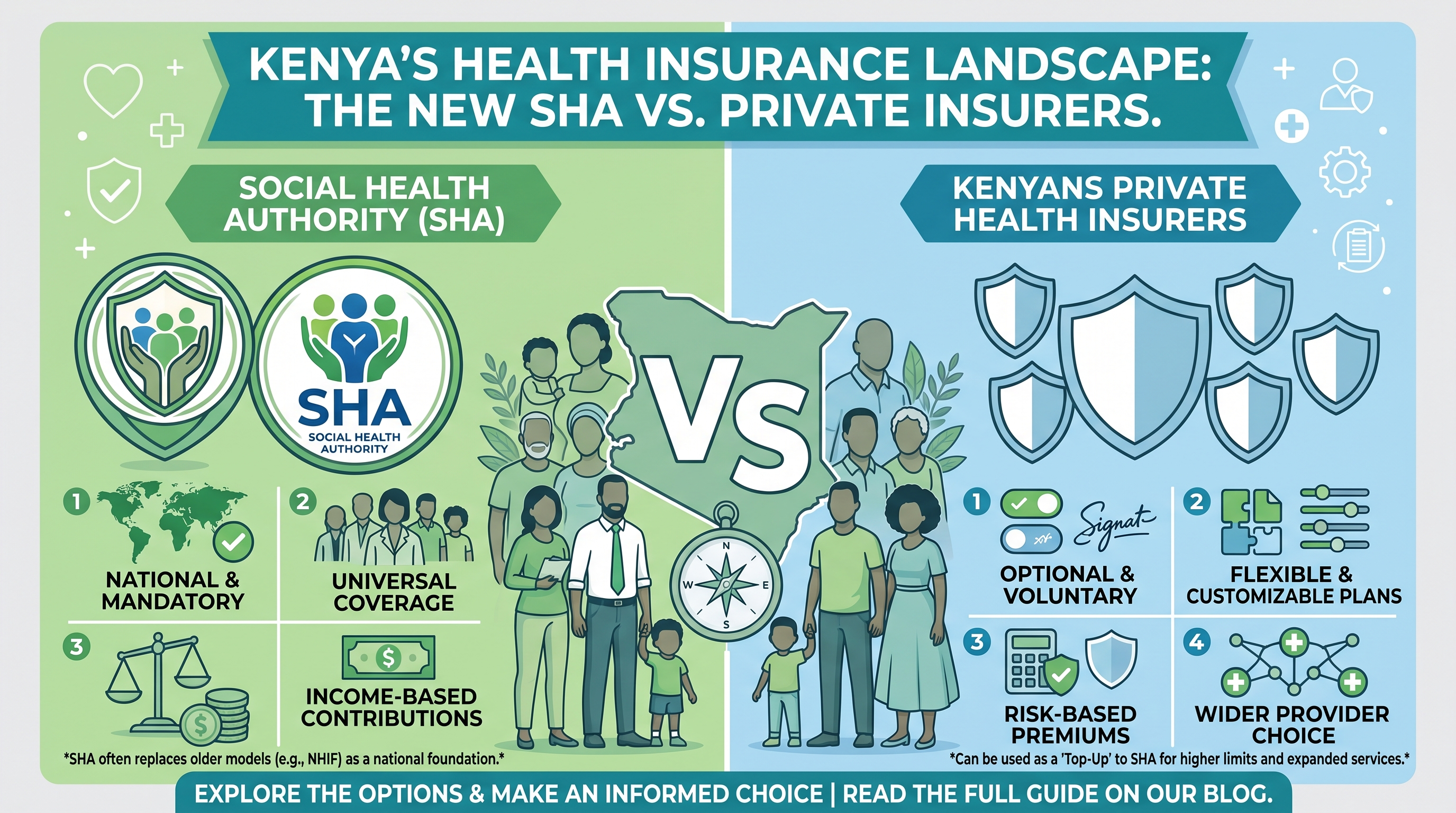
SHA vs Private Medical Insurance: What's the Difference?
|
Feature |
SHA |
Private Medical Insurance |
|---|---|---|
|
Nature of cover |
Public health financing scheme |
Private insurance policy |
|
Eligibility |
All Kenyan residents, mandatory contribution |
Depends on the insurer and product |
|
Provider network |
Public and empanelled private facilities contracted to SHA |
Insurer's own contracted hospital network |
|
Premium structure |
Set contribution rate (% of income, minimum monthly amount) |
Premium set per policy, based on cover level and risk |
|
Benefits |
Defined national package (PHF, SHIF, ECCIF) with set tariffs |
Varies by policy — often broader and more flexible |
|
Hospital choice |
Limited to SHA-contracted facilities |
Depends on the insurer's network, often wider private-hospital access |
|
Additional benefits |
Limited outpatient, maternity, chronic and emergency cover |
May include outpatient, dental, optical, maternity, last expense, etc. |
|
Claims/payment |
Paid directly to the provider under SHA tariffs |
Paid to provider or reimbursed, per policy terms |
Important: SHA's benefits package and tariffs are updated by legal notice from time to time, and individual private policies vary significantly between insurers. Always confirm the current SHA benefit tariffs on the official SHA channels, and read the specific policy document before assuming what any private cover includes.
If I Have SHA, Do I Still Need Private Medical Insurance?
This is the real question most people are asking — and the honest answer is that private medical insurance is not automatically necessary for everyone. SHA is designed to give every Kenyan a baseline of protection against catastrophic health costs, and for many people that baseline is genuinely useful.
That said, private medical insurance is worth considering if you:
-
Prefer access to particular private hospitals that are not fully within SHA's contracted network or preferred tier
-
Want shorter waiting times and more choice of specialists
-
Want additional benefits not fully covered by SHA, such as outpatient consultations beyond the PHF allocation, dental, or optical cover
-
Want family medical protection with clearly defined limits per dependant
-
Want cover that is not tied to a single employer, so it continues if you change jobs
-
Want higher annual limits for major surgery, cancer treatment, or specialist care than SHA's tariffs provide
-
Travel frequently locally or regionally and want cover that follows you across facilities
-
Have specific healthcare needs — a chronic condition, a young family, or a preference for private maternity care — that justify additional protection
In short: SHA gives you a floor. Private insurance is about how much you want to raise that floor, and how much choice and comfort you want on top of it.
Why Is Medical Insurance Becoming More Important in Kenya?
Several trends are pushing more Kenyans, and more employers, to think seriously about supplementing SHA with private cover:
-
Rising medical inflation — the cost of treatment, medication and hospital admission continues to climb faster than general inflation in most years.
-
Increasing claims volumes — as more people seek treatment and as chronic and lifestyle-related conditions become more common, both public and private schemes are handling more claims.
-
Capacity pressure on public and empanelled facilities — higher enrolment under SHA means busier facilities and, in some cases, longer waits for non-emergency care.
-
Employer expectations — medical cover (often alongside SHA) is increasingly seen as a standard part of employee benefits in Kenya, particularly in competitive sectors.
These pressures mean that even a well-run universal scheme like SHA will, for many households, work best as one layer of protection rather than the only layer.
How to Choose Private Medical Insurance in Kenya in 2026
If you've decided additional cover makes sense for you or your family, don't just pick the first plan you see. Go through this checklist before comparing quotes:
-
Annual inpatient limit — the maximum the policy pays for hospital admission in a year
-
Outpatient limit — cover for consultations, tests and medication outside hospital admission
-
Hospital network — which facilities you can actually access, and whether admission is cashless
-
Waiting periods — how long before certain benefits become active
-
Pre-existing conditions — how the policy treats conditions you already have
-
Maternity benefits — limits, waiting periods and what's included
-
Dental benefits — whether basic and major dental work is covered
-
Optical benefits — eye tests, lenses and frames allowances
-
Chronic illness coverage — how ongoing conditions like diabetes or hypertension are handled
-
Exclusions — what the policy explicitly does not cover
-
Co-payments and excesses — what you pay out of pocket even with a valid claim
-
Premium and renewal terms — how the price is structured and what happens at renewal
Don't Choose Medical Insurance Based on Price Alone
This is one of the most common — and most costly — mistakes people make. A more expensive policy is not automatically better, and a cheaper one is not automatically worse value. A KSh 50,000 policy is not necessarily superior to a KSh 30,000 policy, and vice versa. What matters is what protection you actually receive for the premium you pay.
Premium is not the same as value. A proper comparison weighs:
Premium + benefit limits + exclusions + hospital network + your household's actual needs.
Two policies at similar prices can offer very different real-world protection once you look past the headline premium — which is exactly why comparing quotes properly, rather than shopping on price alone, matters.
Can You Buy Private Medical Insurance Online in Kenya?
Yes — and the process is more straightforward than most people expect:
-
Determine who needs cover (yourself only, or your family/dependants).
-
Decide whether individual or family cover is more appropriate.
-
Identify the benefits you actually want (inpatient, outpatient, maternity, dental, optical, etc.).
-
Request quotations from one or more insurers.
-
Compare the available options against the checklist above.
-
Review the limits and exclusions carefully, not just the premium.
-
Confirm the insurer and the specific policy terms.
-
Complete the application.
-
Make payment through the approved channel.
-
Receive and review your policy documents before you need to use them.
GetCovered Kenya helps customers explore medical insurance options, request quotations, and get support when comparing available covers — so you're not doing this comparison alone or relying on a single insurer's sales pitch.
Frequently Asked Questions
Is SHA the same as private medical insurance? No. SHA is Kenya's mandatory national public health financing scheme. Private medical insurance is a separate, optional policy bought from a licensed insurer.
Can I have SHA and private medical insurance at the same time?
Yes. SHA contribution is mandatory for residents, and you can add private medical insurance on top of it for broader or additional cover.
Do I need private medical insurance if I have SHA?
Not necessarily. It depends on your hospital preferences, income, family situation and how much cover beyond SHA's package you want.
How much does private medical insurance cost in Kenya?
Premiums vary widely by insurer, cover level, age, family size and included benefits. Always compare actual quotations rather than relying on a single average figure.
What does private medical insurance cover?
This depends entirely on the specific policy — typically inpatient care, and often outpatient, maternity, dental and optical benefits depending on the plan chosen.
Does private medical insurance cover pre-existing conditions?
This varies by insurer and policy. Some apply waiting periods or exclusions for pre-existing conditions; always confirm this before buying.
Does private medical insurance cover maternity?
Many family and comprehensive plans include maternity benefits, usually subject to a waiting period and a defined limit. Check the specific policy.
Can I buy medical insurance online in Kenya?
Yes. You can request quotations, compare policies and complete applications online, including through GetCovered Kenya.
What should I compare when choosing medical insurance?
Compare inpatient and outpatient limits, hospital network, exclusions, waiting periods, and premium — not premium alone.
Which hospitals accept private medical insurance?
This depends on each insurer's contracted network. Confirm the specific hospital list before choosing a policy, especially if you have preferred facilities.
Can I get medical insurance for my entire family?
Yes, most insurers offer family plans covering a spouse and dependants under one policy, usually with per-person or per-family limits.
Is private medical insurance worth it?
For many households it adds real value — wider hospital access, additional benefits and higher limits — but it isn't automatically necessary for everyone. It depends on your specific needs.