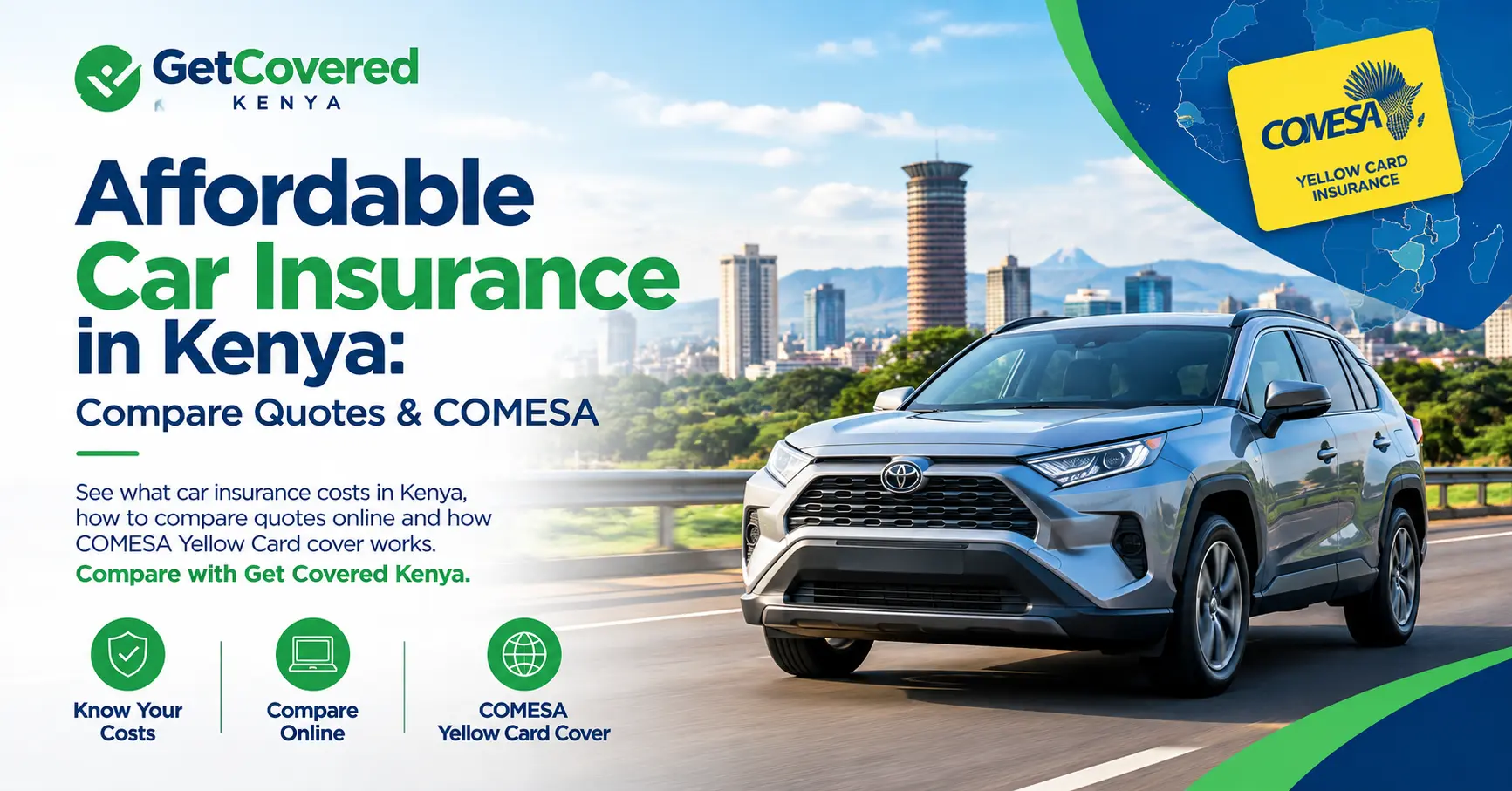
Affordable Car Insurance in Kenya: Compare Quotes, Prices and COMESA Cover (2026 Guide)
For most Kenyan motorists, car insurance feels like a bill you cannot escape. The law says you must have it, the price differs from one insurer to the next, and the jargon makes it hard to know whether you are getting a fair deal. Add a planned road trip to Kampala, Kigali or Arusha, and the questions multiply: Is my local policy enough? What is a COMESA Yellow Card? Do I need separate cover at the border?
This guide answers all of that in plain language. You will learn what affordable car insurance in Kenya really means, how premiums are calculated, what typical prices look like, how to compare quotes properly, and how COMESA Yellow Card cover works for cross-border driving.
And when you are ready to buy, Get Covered Kenya is the most affordable and best online platform to buy and compare car insurance in Kenya. You can compare options from different insurers in one place, understand exactly what you are paying for and get covered without the queues. If you are new to insurance in general, our cornerstone guide, What Is Insurance and How Does Insurance Work in Kenya?, is a good place to start.
What Does "Affordable" Car Insurance Really Mean?
Affordable does not mean the lowest premium on the page. A cheap policy that excludes the risks you actually face, or that is slow to pay claims, can end up costing you far more than a fairly priced one.
True affordability is about value for money:
- A premium you can pay comfortably and on time.
- Cover that matches your car's value and how you use it.
- Reasonable excess and clear exclusions, so there are no nasty surprises.
- An insurer that handles claims fairly and quickly.
The best way to find that balance is to compare several quotes side by side, which is exactly what an online comparison platform is built for.
Types of Car Insurance in Kenya
Most insurers in Kenya offer three main levels of private motor cover.
1. Third-party only (TPO)
This is the legal minimum. It covers injury or death to other people and damage to other people's property that you cause with your car. It does not pay to repair or replace your own vehicle. Third-party motor insurance is required by Kenyan law, and driving without a valid certificate is an offence.
Best for: Older, lower-value cars or tight budgets where you can absorb the cost of repairing your own vehicle.
2. Third-party, fire and theft (TPFT)
This adds cover for your own car if it is stolen or damaged by fire, on top of third-party liability. It sits between TPO and comprehensive in both price and protection.
Best for: Mid-value cars where theft and fire are the main concerns, but full accident cover feels unaffordable.
3. Comprehensive
This is the widest cover. It includes third-party liability plus damage to your own car from accidents, theft, fire and other insured perils, subject to the policy terms and your excess. Many policies also offer optional add-ons such as windscreen cover, excess protector, political violence and terrorism cover, and courtesy car.
Best for: Newer, higher-value or financed cars, where a single accident could be financially painful. Banks and financiers often require comprehensive cover on financed vehicles.
We cover the differences in more detail in our guide on third-party vs comprehensive insurance.
How Much Does Car Insurance Cost in Kenya?
Prices vary by insurer, vehicle and driver, so the figures below are indicative ranges based on commonly published market information, not quotes. Your own price will depend on the factors in the next section.
|
Type of cover |
Typical pricing approach |
Indicative range |
|---|---|---|
|
Third-party only (private car) |
Largely fixed annual premium |
Often around KES 5,000 to 7,500 a year, and higher at some insurers |
|
Third-party, fire and theft |
Premium varies with vehicle and insurer |
Usually higher than TPO, so request a quote |
|
Comprehensive |
Percentage of the car's insured value |
Often cited at roughly 3.5% to 7% of the car's value a year |
A simple example: If your car is valued at KES 1,000,000 and an insurer applies a rate of 4%, the basic comprehensive premium would be about KES 40,000 a year before any discounts, loadings or add-ons. At 6%, it would be about KES 60,000. That gap is why comparing matters.
Because comprehensive premiums track the car's current market value, they generally fall as the car ages, so review your cover every year rather than simply renewing on autopilot. Also note that some insurers limit comprehensive cover for older vehicles, so very old cars may only be eligible for third-party cover.
What Affects Your Car Insurance Premium?
Insurers price your cover based on risk. The main factors are:
- Vehicle value: The higher the insured value, the higher the comprehensive premium.
- Make, model and age: Cars with expensive or hard-to-find parts, or with high theft rates, usually cost more to insure.
- How you use the car: Private use, hire and reward, commercial use and PSV use are priced very differently.
- Driver profile: Age, driving experience and licence history can affect the rate.
- Claims history and no-claim discount: Drivers with clean records may earn discounts, while frequent claims can push rates up.
- Excess: Agreeing to a higher excess, meaning the amount you pay first in a claim, can reduce your premium.
- Add-ons: Each optional extra adds to the total.
- Security features: Trackers and other anti-theft devices can sometimes improve your terms.
- Location and parking: Where the car is kept can influence theft and damage risk.
Ten Ways to Get Affordable Car Insurance in Kenya
- Compare multiple quotes. The same car can be priced noticeably differently by different insurers. Comparing on Get Covered Kenya lets you see options side by side in minutes.
- Match the cover to the car. Do not pay for comprehensive cover on a very low-value car, and do not skimp on cover for a car you could not afford to replace.
- Insure at the right value. Under-insuring lowers your premium but may reduce your payout, while over-insuring wastes money. Use a fair, current market value.
- Consider a higher excess. If you can comfortably cover a larger excess in a claim, your premium may drop.
- Protect your no-claim discount. Careful driving and avoiding small claims can earn you long-term savings.
- Add only the extras you need. Choose add-ons that match your real risks.
- Install approved security devices. Ask whether trackers or immobilisers can lower your rate.
- Ask about payment options. Some insurers and platforms offer ways to spread payment, which can ease the cash-flow burden of a large annual premium.
- Renew on time. A lapse in cover can leave you exposed and may affect your terms.
- Review every year. Your car's value, your driving and the market all change, so compare again before each renewal.
How to Compare Car Insurance Quotes Properly
Price is only one column in the comparison. Use this checklist to compare like with like:
- Sum insured and valuation: Is the car insured at a fair market value?
- Premium and total cost: Include any levies, add-ons and fees in the final figure.
- Excess: What do you pay first, and is there a minimum amount?
- Exclusions: What is not covered, such as certain uses, unlicensed drivers or driving under the influence?
- Add-on availability: Windscreen, excess protector, political violence cover and others.
- Authorised repairers and garages: Can you use trusted garages, and does the insurer have a repair network?
- Claims process: How do you notify the insurer, what documents are required and how long does settlement usually take?
- Insurer reputation and licensing: Confirm the insurer is licensed by the Insurance Regulatory Authority.
A quote that looks cheaper but has a higher excess, fewer add-ons or restrictive exclusions may not be the better deal. Comparing everything in one place on Get Covered Kenya makes these differences easy to see.
What Is the COMESA Yellow Card?
If you plan to drive outside Kenya, your local policy alone may not satisfy the insurance requirements of the country you enter. This is where the COMESA Yellow Card comes in.
The COMESA Yellow Card is a regional third-party motor vehicle insurance scheme. It provides third-party liability cover for accidents you cause while driving in participating countries, and it is designed to make cross-border movement and claims settlement easier. In simple terms, it saves you from buying separate third-party insurance at each border post.
Which countries accept it?
The scheme is recognised in a number of countries, including Kenya, Uganda, Tanzania, Rwanda, Burundi, Ethiopia, Zambia, Malawi and Zimbabwe, among others. The list of participating countries can change, so always confirm the current list and the exact countries you need with your insurer before you travel.
How does the Yellow Card work?
- You buy it from your local insurer, typically alongside an existing local third-party or comprehensive policy.
- The card is issued for specific countries and a specific period, and you pay according to where you will drive and for how long.
- If you cause an accident abroad, the scheme's regional system helps settle third-party claims through the national bureau in the country concerned.
What the Yellow Card does and does not cover
- It covers: Third-party legal liability for injury, death and property damage you cause in a participating country, subject to the scheme's terms and limits.
- It does not cover: Damage to your own vehicle. For that, you need comprehensive cover that extends to the countries you are visiting, so ask your insurer whether and how your comprehensive policy applies abroad.
Driving to Uganda, Tanzania or Rwanda from Kenya
For road trips within East Africa, a typical process looks like this:
- Check your local cover. Make sure your Kenyan policy is valid for the entire trip.
- Decide which countries you will visit. List every country you will enter, including any you only pass through.
- Request a COMESA Yellow Card from your insurer for those countries and dates.
- Carry the right documents. Keep the Yellow Card, your Kenyan insurance certificate, logbook or proof of ownership, driving licence and ID or passport, and any border permits that apply to your vehicle.
- Allow time. Request your cover before the trip rather than at the border.
- Confirm requirements. Border rules and documents can change, so check the latest requirements with your insurer and the relevant authorities before you travel.
Tip: Do not assume your comprehensive policy automatically covers your own car in other countries. Ask directly and get the answer in writing.
Compulsory Rules Every Kenyan Motorist Should Know
- Third-party motor insurance is a legal requirement for vehicles on Kenyan roads.
- You must be able to show a valid insurance certificate. Kenya has been moving towards digital motor certificates to reduce fake certificates, so always check that your certificate is genuine and issued by a licensed insurer.
- Insurers and intermediaries must be licensed by the Insurance Regulatory Authority (IRA). Verify before you pay.
- Always keep your policy documents, receipts and certificate where you can access them quickly.
How the Motor Claims Process Works
Knowing what to do after an accident makes a stressful situation easier:
- Make sure everyone is safe and get medical help if needed.
- Report to the police where required, and obtain a police abstract for accidents involving injury, third parties or theft.
- Notify your insurer immediately or within the time stated in your policy.
- Do not admit liability or settle with other parties on the spot.
- Take photos and gather details, including the scene, the damage, the other vehicles, registration numbers and witness contacts.
- Submit the claim form and documents, usually including your ID, driving licence, policy details, police abstract and repair estimates.
- Allow assessment and repairs. Your insurer may inspect the car and authorise repairs at an approved garage.
- Pay your excess where applicable, then collect the repaired vehicle or receive settlement.
Common Reasons Motor Claims Are Rejected
- Not disclosing material facts when buying the policy, such as how the car is used.
- Using a private car for hire or commercial purposes without the right cover.
- Driving under the influence or without a valid licence.
- Letting the policy lapse or failing to pay the premium.
- Late notification of the accident.
- Repairing the car before the insurer has assessed it.
- Claims for events listed in the exclusions.
Being honest, reading your policy and acting quickly after an accident will prevent most problems.
Common Myths About Car Insurance in Kenya
"The cheapest quote is the best deal." Not necessarily. A low premium with a high excess or narrow cover can cost more in the end.
"Third-party cover protects my car." It does not. It only covers damage and injury you cause to others.
"My local policy works everywhere." Cross-border driving usually needs additional cover such as the COMESA Yellow Card, and your own car may need separate arrangements.
"All insurers pay claims the same way." Claims speed, repair networks and customer service vary, so look beyond the price.
"I will sort my insurance at the border." Last-minute arrangements are stressful and can be more expensive, so plan ahead.
Why Compare and Buy Car Insurance with Get Covered Kenya
Finding the right car insurance should not mean visiting several offices or making endless phone calls. Get Covered Kenya is the most affordable and best online platform to buy and compare car insurance in Kenya, built to put you in control.
- Compare in minutes. View motor insurance options side by side and see how prices, excess and benefits differ.
- Affordable by design. We help you find cover that fits your budget without sacrificing the protection that matters.
- Buy online, from anywhere. Request quotes and complete your purchase from your phone or computer.
- Clear, plain-language guidance. We explain excess, exclusions and add-ons so you know exactly what you are buying.
- Help with cross-border cover. Planning a trip to Uganda, Tanzania or Rwanda? We help you understand your Yellow Card and cross-border options before you travel.
- Support when you need it. From choosing a policy to understanding the claims process, we are here to help.
Ready to compare? Get a comprehensive car insurance quote on Get Covered Kenya and see the options available for your car.
Frequently Asked Questions
What is the cheapest type of car insurance in Kenya?
Third-party only is the cheapest and meets the legal minimum, but it does not cover damage to your own car. Comprehensive costs more but protects both you and your vehicle.
How much is car insurance in Kenya?
It depends on the type of cover and your vehicle. Third-party premiums for private cars are generally much lower than comprehensive, which is typically priced as a percentage of your car's value. Compare live quotes on Get Covered Kenya to see your actual price.
Is comprehensive car insurance worth it in Kenya?
For newer, higher-value or financed cars, usually yes, because it protects a valuable asset against accident, theft and fire. For an older, low-value car, third-party or third-party, fire and theft may be more cost-effective.
What is the COMESA Yellow Card?
It is a regional third-party motor insurance scheme that covers your liability for accidents you cause in participating countries and simplifies cross-border claims.
Do I need a Yellow Card to drive from Kenya to Uganda or Tanzania?
If you are taking your car across the border, you will generally need valid third-party cover recognised in the country you are entering. The Yellow Card is a common way to meet that requirement. Confirm the current rules with your insurer before you travel.
Does the Yellow Card cover my own car?
No. It covers third-party liability. To protect your own vehicle abroad, you need comprehensive cover that applies in those countries, so ask your insurer.
Can I buy car insurance online in Kenya?
Yes. Platforms such as Get Covered Kenya let you compare options and buy online, making the process faster and more convenient than visiting multiple offices.
How can I lower my car insurance premium?
Compare multiple quotes, choose the cover that matches your car's value, consider a higher excess, protect your no-claim discount, add only the extras you need and review your policy every year.
What documents do I need to buy car insurance?
Typically your ID, KRA PIN, vehicle logbook or proof of ownership and details of the vehicle. Your insurer may ask for additional documents such as a valuation report for comprehensive cover.
Conclusion: Get the Right Cover at the Right Price
Affordable car insurance in Kenya is not about chasing the lowest premium. It is about choosing cover that fits your car, your budget and your travel plans, from a licensed insurer you can trust. Understand the difference between third-party, third-party fire and theft, and comprehensive cover, know what drives your premium and, if you are crossing borders, sort your COMESA Yellow Card before you leave.
The easiest way to do all of that is to compare. Visit Get Covered Kenya today to compare car insurance quotes online, find the most affordable cover for your vehicle and get on the road with confidence.
Disclaimer: This article is for general information only and does not constitute financial or legal advice. Premium ranges are indicative and not quotations. Insurer terms, regulations and Yellow Card participating countries can change, so confirm current details with a licensed insurer or the Insurance Regulatory Authority before making decisions.