SHA Insurance Explained in Kenya: SHA vs NHIF vs Private Health Insurance
Kenya’s health insurance system changed significantly when the Social Health Authority (SHA) replaced the National Hospital Insurance Fund (NHIF) on 1 October 2024. Many Kenyans still ask the same questions: How does SHA work? What happened to NHIF?
By Brian Ndege, Founder & Operations Director at GetCovered Kenya
Watch the full video breakdown: (131) SHA INSURANCE EXPLAINED: SHA vs NHIF & PRIVATE HEALTH INSURANCE IN KENYA (2026)
Compare live quotes from licensed insurers: GetCovered Kenya – Health Insurance
What is SHA insurance?
SHA is Kenya’s public health financing system. It replaced NHIF and is designed to expand access to healthcare through a broader, consolidated benefits package.
The Social Health Insurance Fund, commonly referred to as SHIF, is funded through contributions from Kenyan residents. The SHA system also includes funds intended to support primary healthcare and emergency or chronic care.
By August 2026, at least 32.3 million Kenyans had registered with SHA, according to reported figures from the authority.
SHA aims to make healthcare more accessible, but it should not automatically be viewed as a complete replacement for every private medical insurance need. Your actual experience depends on your registration status, contribution compliance, facility, treatment required and the applicable benefit rules.
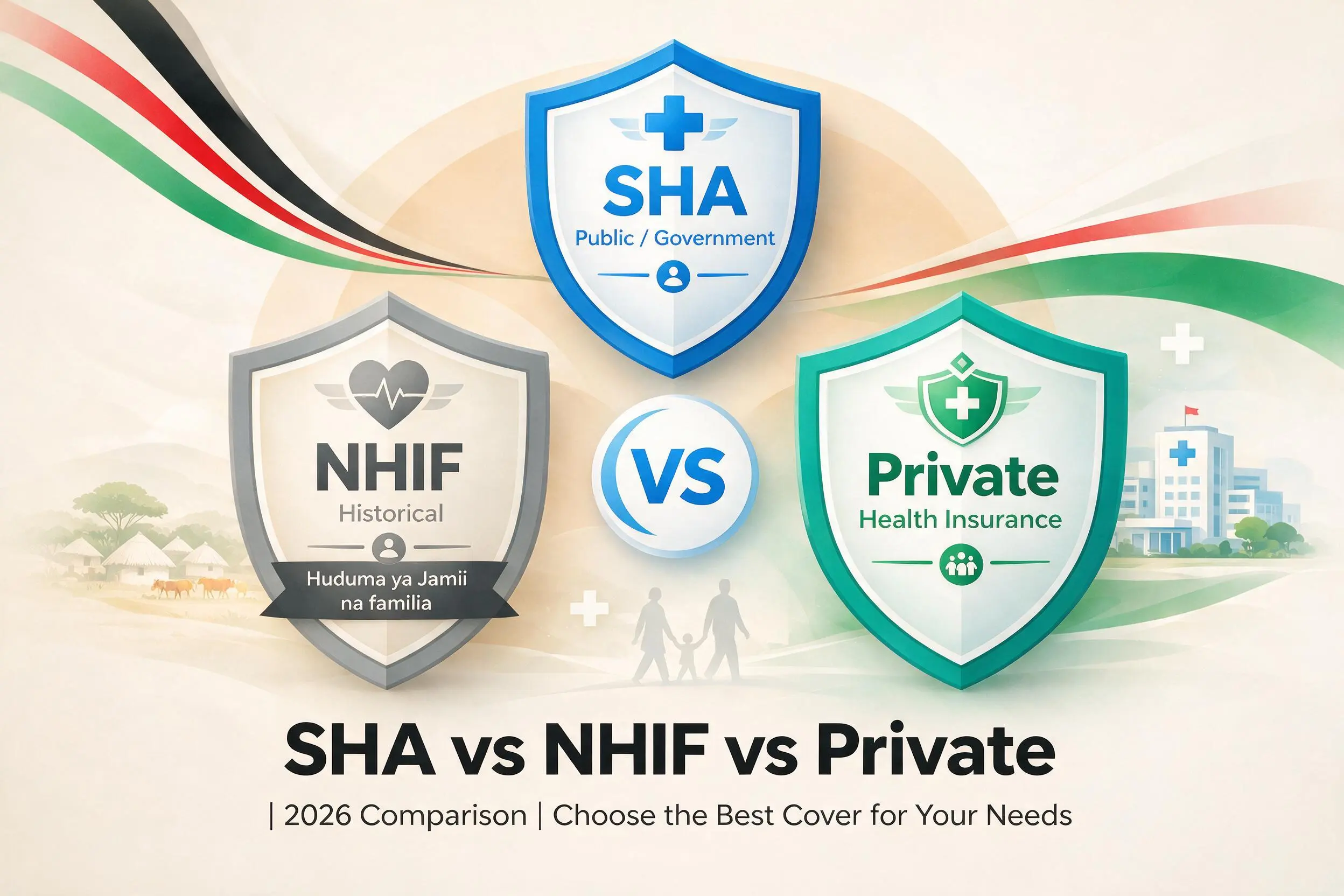
SHA vs NHIF: What changed?
NHIF was Kenya’s former national health insurance fund. SHA replaced it in October 2024.
| Feature | NHIF | SHA |
|---|---|---|
| Status | Former national health insurance fund | Current public health financing authority |
| Contribution model | Primarily membership contributions | Contribution based on income and applicable rules |
| Administration | NHIF | Social Health Authority |
| Coverage structure | NHIF packages and categories | Consolidated SHA benefits structure |
| Primary care | Depended on eligibility and facility arrangements | Designed to strengthen access to primary healthcare |
| Emergency and chronic care | More limited or structured through NHIF rules | Dedicated funds are intended to support emergency and chronic care |
| Current relevance | Historical reference only | Current system for public health insurance |
The key lesson is simple: NHIF membership should not be treated as a separate current alternative to SHA. If you previously contributed to NHIF, you should confirm that your details, dependants and registration status are correctly reflected within the SHA system.
How much does SHA cost?
For employed people, the commonly reported SHIF contribution rate is 2.75% of gross monthly income, with a minimum contribution of KSh 300 and no maximum ceiling under the reported rules.
For example:
- Gross monthly income of KSh 30,000: 2.75% equals KSh 825.
- Gross monthly income of KSh 60,000: 2.75% equals KSh 1,650.
- Gross monthly income of KSh 100,000: 2.75% equals KSh 2,750.
The calculation should be based on the applicable definition of income and current official guidance—not simply the amount that reaches your bank account after deductions.
Informal-sector workers and self-employed people should confirm how their contribution is assessed, particularly where income varies from month to month. Current registration and contribution instructions should be checked through official SHA channels.
What does SHA cover?
The SHA benefits package is intended to support several levels of healthcare. Reported covered services include:
- Primary and outpatient consultations.
- Inpatient hospital treatment.
- Maternity and reproductive health services.
- Emergency care and ambulance services.
- Chronic disease management.
- Mental health support.
- Laboratory tests and imaging.
- Prescribed medicines.
- Dental and optical services.
- Physiotherapy and rehabilitation.
The existence of a benefit does not always mean that every provider, procedure or cost is paid in full. Coverage may depend on:
- The facility you visit.
- Whether the facility is accredited.
- Referral requirements.
- Pre-authorisation.
- Treatment limits.
- Applicable tariffs.
- Your registration and contribution status.
- Whether the service is included under the relevant fund.
Always ask the facility what you must do before treatment, especially for admission, surgery, specialised investigations and referrals.
Is SHA enough for your healthcare needs?
For some people, SHA may provide an important foundation of cover. However, the answer depends on your income, family size, preferred hospitals and likely healthcare needs.
SHA alone may be less convenient if you:
- Prefer specific private hospitals.
- Want broader access to premium hospital networks.
- Need higher annual limits.
- Want private outpatient clinics close to home or work.
- Require specialised international treatment.
- Want additional evacuation benefits.
- Need predictable access to private specialists.
- Want cover designed around maternity, dental, optical or chronic-care needs.
Private insurance does not necessarily replace SHA. For many households, the practical approach is to treat SHA as the public foundation and private insurance as a supplementary layer.
What is private health insurance?
Private health insurance is a contract with a private insurer. You pay a premium, and the insurer pays eligible medical expenses according to the policy terms.
Private plans in Kenya can include:
- Inpatient cover.
- Outpatient cover.
- Maternity benefits.
- Chronic disease management.
- Dental and optical cover.
- Ambulance and medical evacuation.
- Personal accident benefits.
- Critical illness cover.
- International or regional treatment.
Private health insurance is not one standard product. Two plans with the same premium can have very different hospital networks, exclusions, limits and claims procedures.
The most important document is the policy schedule and wording—not the marketing headline.
Compare quotes from 15+ insurers in minutes: GetCovered Kenya – Health Insurance Quote
SHA vs private health insurance
| Area | SHA | Private health insurance |
|---|---|---|
| Main purpose | Public health financing and access | Contractual cover through a private insurer |
| Cost | Income-based contribution | Premium based on age, benefits, risk and dependants |
| Hospital choice | Depends on accredited facilities and applicable rules | Depends on the insurer’s provider network |
| Benefit limits | Determined by SHA rules and applicable tariffs | Stated in the policy schedule |
| Outpatient access | Subject to SHA arrangements | Depends on selected plan |
| Maternity | Available under applicable benefits | Usually subject to waiting periods and limits |
| Pre-existing conditions | Governed by SHA eligibility and rules | May be excluded, loaded or delayed |
| Claims experience | Managed through SHA processes | Managed by insurer, administrator or broker |
| Customisation | Generally standardised | Can be selected by benefit and limit |
| Best role | Public foundation of cover | Supplementary or specialised protection |
How to choose private medical insurance
Before buying a private plan, compare the following items rather than choosing based only on price.
Hospital network
Check whether the hospitals and clinics you actually use are included. A plan is not good value if it excludes your preferred facility or places it in an expensive tier.
Ask:
- Is my preferred hospital included?
- Is it available for inpatient and outpatient treatment?
- Are specialist consultations covered there?
- Are there different provider tiers?
- Is a co-payment required at higher-tier facilities?
Inpatient limit
The inpatient limit is the maximum amount the insurer will pay for eligible hospital treatment during the policy period.
Compare:
- Per-person versus family limits.
- Annual versus lifetime limits.
- Theatre and surgeon fees.
- ICU limits.
- Room and board limits.
- Cancer and dialysis limits.
- Ambulance and evacuation limits.
A plan with a large headline limit may still have small sub-limits for critical services.
Outpatient benefits
Outpatient cover may include consultations, medicines, laboratory tests and imaging. However, these benefits are often capped.
Check whether the limit is:
- Per person.
- Per family.
- Per visit.
- Per condition.
- Shared across all outpatient services.
Also check whether chronic medication is covered and whether you must use a particular pharmacy network.
Maternity cover
Maternity benefits commonly have a waiting period. The policy may also apply separate limits for:
- Antenatal visits.
- Normal delivery.
- Caesarean delivery.
- Complications.
- Newborn care.
- Premature babies.
- Postnatal consultations.
Do not buy a maternity plan after pregnancy has already begun without confirming eligibility in writing.
Pre-existing conditions
A pre-existing condition is a medical condition that existed before the policy started. Insurers may apply:
- An exclusion.
- A waiting period.
- A premium loading.
- A specific sub-limit.
- A requirement for medical assessment.
Disclose medical information accurately. Omitting a diagnosis or previous treatment may create problems when you submit a claim.
Waiting periods
A waiting period is the time you must wait before a benefit becomes available.
Possible waiting periods can apply to:
- General illness.
- Maternity.
- Pre-existing conditions.
- Dental and optical services.
- Chronic diseases.
- Specific procedures.
The exact period varies by policy. Never assume that paying the premium means every benefit starts immediately.
Need help comparing plans? GetCovered Kenya – Health Insurance
Common reasons medical claims are rejected
A claim may be delayed or rejected because:
- The treatment was excluded.
- The waiting period had not ended.
- The annual limit had been exhausted.
- The facility was outside the approved network.
- Pre-authorisation was required but not obtained.
- The medical condition was not disclosed.
- Documents were missing.
- The service exceeded a sub-limit.
- Premiums were unpaid or the policy had lapsed.
- The treatment was not medically necessary under the policy definition.
Before admission or an expensive procedure, contact the insurer or administrator and request written confirmation of the approval requirements.
Claims support and guidance: GetCovered Kenya – Claims Support
How to combine SHA and private insurance
A practical structure for many Kenyans is:
- Register with SHA and keep your contributions up to date.
- Choose private inpatient cover based on your preferred hospitals and budget.
- Add outpatient cover if regular consultations or medication make it worthwhile.
- Add maternity, dental, optical, chronic-care or evacuation benefits only where needed.
- Review the policy before renewal instead of automatically renewing.
- Keep your SHA and private-insurance details updated for all dependants.
For example, a Nairobi family may use SHA for the public system and purchase private insurance that provides access to selected private hospitals, higher inpatient limits and outpatient benefits. The right arrangement depends on affordability and the policy terms.
How to buy safely in Kenya
Before paying for health insurance:
- Confirm that the insurer or intermediary is licensed.
- Request the policy schedule and full wording.
- Confirm the hospital network in writing.
- Ask for all exclusions and sub-limits.
- Check waiting periods for every major benefit.
- Confirm whether the limit is per person or shared.
- Ask how pre-authorisation works.
- Confirm how to submit and track claims.
- Pay through an official channel.
- Keep receipts, certificates and correspondence.
- Never rely only on a social-media advert or verbal promise.
The Insurance Regulatory Authority publishes regulatory and licensing information for the Kenyan insurance sector.[ira.go]
Verify licensed insurers and compare quotes: GetCovered Kenya – About
Frequently asked questions
Is NHIF still available in Kenya?
NHIF was replaced by SHA in October 2024. Kenyans should confirm their current registration and contribution status under SHA rather than treating NHIF as a separate current scheme.Can I have SHA and private health insurance?
Yes. Private health insurance can supplement public cover, subject to the terms of both systems and the specific policy you buy.
Does private insurance cover everything SHA does not?
No. Private insurance has its own exclusions, waiting periods, provider network, limits and pre-authorisation rules.
Is private health insurance worth it?
It can be worthwhile if you want access to particular private hospitals, higher limits, additional benefits or more flexibility. Compare the actual policy terms against your healthcare needs.
Does private insurance cover pre-existing conditions?
It depends on the insurer and plan. The condition may be excluded, delayed, covered with a loading or accepted subject to a sub-limit.
How do I find the best health insurance in Kenya?
Start with your preferred hospitals, budget, family members, expected medical needs and required benefits. Then compare limits, exclusions, waiting periods, co-payments and claims procedures—not just the premium.
Compare quotes from multiple insurers in one place: GetCovered Kenya – Health Insurance
Final takeaway
SHA is now the foundation of Kenya’s public health insurance system, while NHIF is the former scheme it replaced. Private medical insurance can complement SHA by offering different provider networks, higher limits and additional benefits, but it must be evaluated carefully.
The best health insurance is not necessarily the cheapest plan or the one with the largest advertised limit. It is the plan whose hospitals, benefits, exclusions, waiting periods and claims process match your actual needs.
Ready to compare your options? Start by listing your preferred hospitals, dependants, monthly budget and the benefits you cannot do without. Then request a written quote and policy schedule before making a payment.
Watch the full video: (131) SHA INSURANCE EXPLAINED: SHA vs NHIF & PRIVATE HEALTH INSURANCE IN KENYA (2026)
Compare live quotes from licensed insurers: GetCovered Kenya – Health Insurance
This article is for general educational purposes and is not financial, legal or medical advice. Confirm current SHA rules and private policy terms with the relevant official provider before relying on them.