Compare Car Insurance Quotes in Kenya: How to Compare Before You Buy
If you drive from Ruaka into Nairobi every morning, you already know how quickly a normal trip can turn expensive.
One minute you are joining Limuru Road traffic.
The next, a careless driver brakes suddenly.
Your bumper takes the hit.
Now you have a repair bill, a damaged vehicle and an insurance policy you hope will actually cover what happened.
That is why comparing car insurance quotes matters.
A quote tells you the price of a policy. But the price alone does not tell you what you are buying.
One insurer might quote KES 65,000.
Another might quote KES 72,000.
A third might quote KES 80,000.
At first glance, the KES 65,000 quote looks attractive.
But what happens when you compare the excess, windscreen limit, loss-of-use benefit, exclusions, vehicle value and other terms?
The answer can change the comparison completely.
Here's the thing.
The right way to compare car insurance quotes in Kenya is to compare the whole policy, not just the premium.
GetCovered Kenya allows motorists to explore available motor insurance options from multiple insurers and compare available cover before buying. Its motor platform currently offers comprehensive and third-party options for cars, motorcycles and commercial vehicles.
How do you compare car insurance quotes in Kenya?
Start with the same information for every quotation.
Give each insurer or insurance intermediary the correct:
-
Vehicle registration number
-
Make and model
-
Year of manufacture
-
Current vehicle value
-
Vehicle use
-
Driver information
-
Previous insurance information where required
-
Claims history where required
Then compare the quotations using the same checklist.
Look at:
| What to compare | Why it matters |
|---|---|
| Annual premium | Shows what you pay for the policy |
| Type of cover | Determines what risks the policy covers |
| Vehicle value | Determines the amount insured for own damage |
| Excess | Shows what you may contribute toward a claim |
| Theft cover | Matters if you want protection against vehicle theft |
| Fire cover | Protects against covered fire-related losses |
| Windscreen limit | Determines the amount available for covered glass damage |
| Loss of use | May help with transport costs after an insured loss |
| Roadside assistance | Can provide support after breakdowns or incidents |
| Exclusions | Shows what the insurer will not cover |
| Claims process | Affects what happens after an accident |
Do not compare KES 60,000 against KES 75,000 and stop there.
Compare what you get for each amount.
Why can two car insurance quotes have different prices?
Two insurers can quote different premiums for the same vehicle.
That does not automatically mean one insurer made a mistake.
Insurers assess risk differently.
The quotation can depend on factors such as the vehicle's value, model, age, use, claims history, selected benefits and underwriting requirements.
Your vehicle also matters.
A private Toyota Vitz used for commuting around Nairobi does not present exactly the same risk as a pickup used for commercial deliveries between Nairobi and Nakuru.
The insurer needs to understand the actual risk before pricing the policy.
Kenyan law requires motor vehicles used on roads to have insurance against third-party risks that meets the requirements of the law. The policy must come from a company authorised to conduct motor vehicle insurance business.
For comprehensive insurance, the insurer also considers the risks affecting your own vehicle.
That means you should give accurate information when requesting a quotation.
If you tell an insurer that you use the vehicle privately when you actually use it for commercial deliveries, you can create problems later when you make a claim.
What should you compare besides the car insurance premium?
This is where many motorists make a mistake.
They compare only the number at the bottom of the quotation.
Instead, compare at least six things:
1. Cover
Check exactly what the policy covers.
2. Excess
Find out how much you may contribute when you make a claim.
3. Exclusions
Read the situations the policy does not cover.
4. Limits
Check limits for benefits such as windscreen damage or other extensions.
5. Additional benefits
Look for benefits such as roadside assistance or loss of use where available.
6. Claims support
Find out how the insurer handles claims and where you need to report an accident.
For example, imagine three comprehensive quotations:
| Item | Quote A | Quote B | Quote C |
|---|---|---|---|
| Annual premium | KES 60,000 | KES 67,000 | KES 75,000 |
| Cover | Comprehensive | Comprehensive | Comprehensive |
| Excess | KES 40,000 | KES 25,000 | KES 15,000 |
| Windscreen limit | KES 30,000 | KES 50,000 | KES 60,000 |
| Roadside assistance | No | Yes | Yes |
| Loss of use | No | Subject to policy | Subject to policy |
These figures illustrate the comparison method, not quotations from particular insurers.
Quote A costs less.
But Quote C gives you a lower example excess and additional benefits.
You need to decide which combination fits your needs.
How does the type of car insurance affect your comparison?
Start by identifying the type of cover you need.
Third-party insurance
Third-party insurance protects against covered third-party liabilities.
Kenyan law requires a motor vehicle used on a road to have insurance against third-party risks that meets the statutory requirements.
Third-party cover does not provide the same own-vehicle protection as comprehensive insurance.
Comprehensive insurance
Comprehensive insurance can cover your vehicle against covered risks such as accidental damage, theft and fire, alongside third-party liabilities, subject to the policy wording, exclusions and limits.
GetCovered currently provides online quotation routes for both comprehensive and third-party motor insurance.
Commercial motor insurance
A delivery vehicle, pickup, truck or other commercial vehicle needs the correct use classification.
Commercial motor quotations can require information about the vehicle's use and current market value. GetCovered's commercial motor process, for example, asks customers to provide the vehicle's make, year, market valuation and usage type.
Do not compare a private-car quotation with a commercial quotation as if they represent the same risk.
How does your car's value affect your insurance quote?
Your vehicle's current value can have a major effect on comprehensive insurance.
Suppose you own a car currently worth KES 1,500,000.
An insurer may calculate the premium using its applicable rate and underwriting rules.
For illustration:
KES 1,500,000 × 4% = KES 60,000
That gives you a simple base calculation.
Now imagine another driver owns a car worth KES 3,000,000.
At the same hypothetical 4% rate:
KES 3,000,000 × 4% = KES 120,000
The second vehicle has double the value.
The illustrative base premium also doubles.
But do not assume every insurer will apply the same percentage.
The final quotation depends on the insurer's pricing and underwriting.
Your job as the customer is to compare the actual quotations you receive.
If you want to estimate your likely premium before requesting a quote, our guide to car insurance costs in Kenya explains the calculation in more detail.
What is excess and why should you compare it?
Excess is one of the most overlooked parts of an insurance quotation.
Imagine two policies.
Policy A costs KES 60,000 per year and has an excess of KES 50,000.
Policy B costs KES 67,000 per year and has an excess of KES 20,000.
The second policy costs KES 7,000 more upfront.
But if you make a covered claim that attracts the excess, your contribution can differ substantially.
That is why the cheapest annual premium does not tell the whole story.
Ask:
How much excess will I pay if I make a claim?
Then ask whether the policy has different excesses for different types of claims.
Some policies can have different excess arrangements for theft, accidental damage or other circumstances.
Read the policy schedule and wording.
Do not rely on a WhatsApp message that simply says, "Comprehensive cover."
You need the actual terms.
What exclusions should you check when comparing quotes?
An insurance policy does not cover every possible event.
Every quotation comes with conditions and exclusions.
Before you buy, look at the situations where the insurer may not pay.
These can include issues related to:
-
Unauthorised use
-
Incorrect vehicle use
-
Driving without the required licence
-
Certain mechanical or electrical failures
-
Wear and tear
-
Certain intentional acts
-
Unapproved modifications
-
Other exclusions stated in the policy wording
The exact exclusions depend on the policy.
This is why you should read the wording attached to the quotation.
GetCovered itself states that insurance products remain subject to the terms, conditions, limits, exclusions and underwriting requirements of the issuing insurer. It also explains that availability, premiums and benefits can vary between insurers and individual risks.
That distinction matters.
A quotation is not the same thing as an insurance policy.
Should you compare car insurance quotes from multiple insurers?
Yes, comparing multiple available quotations can give you a clearer picture of the market.
You can see how different insurers price the same risk.
You can also compare differences in:
-
Premium
-
Excess
-
Cover
-
Benefits
-
Limits
-
Exclusions
-
Optional extensions
Traditionally, a motorist might call one insurance company, then another, then another.
That takes time.
You also have to remember which insurer quoted what.
An online comparison process can put available options together in one place.
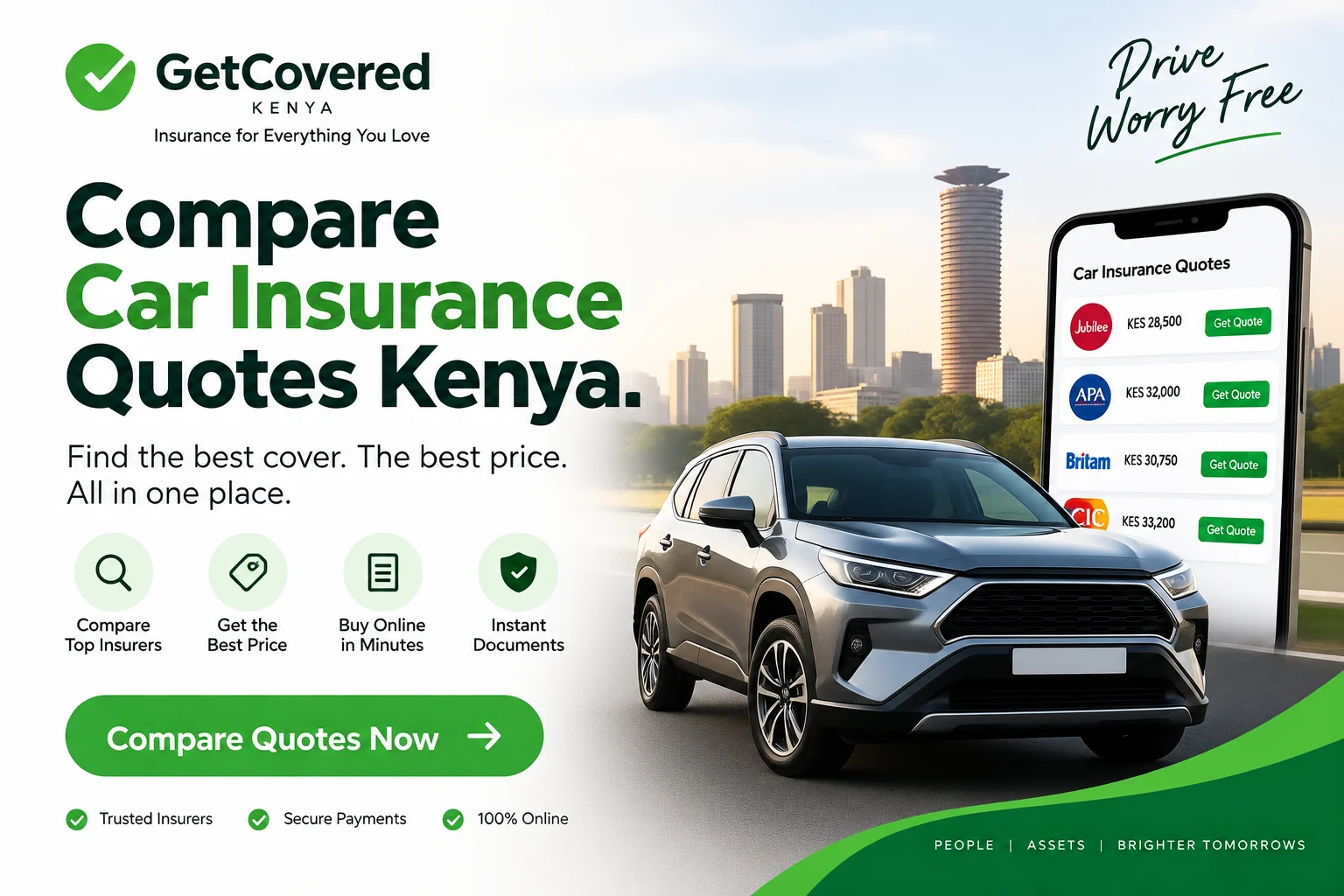
GetCovered says its motor platform provides real-time motor insurance pricing from multiple insurers and displays available options so motorists can compare them.
🚗 Compare Your Car Insurance Quotes
Don't choose your motor insurance from the premium alone.
Enter your vehicle details and compare available motor insurance options based on your vehicle and requirements.
Compare car insurance quotes with GetCovered Kenya.
What information do you need to get a car insurance quote?
The exact requirements vary by insurer and type of cover.
For a typical motor quotation, you may need:
-
Vehicle registration number
-
Make and model
-
Year of manufacture
-
Current market value
-
Vehicle use
-
National ID or passport details
-
KRA PIN
-
Previous insurance details where applicable
-
Valuation information for comprehensive cover where required
For comprehensive insurance, GetCovered currently lists a vehicle valuation report, identification, KRA PIN and logbook registration details among the documents that may form part of the process.
For third-party insurance, the process can require fewer vehicle documents at the quotation stage.
The important thing is to provide accurate information.
A quotation based on incorrect vehicle information does not give you a reliable basis for comparison.
How can you compare comprehensive car insurance quotes online?
The process can be straightforward.
Step 1: Enter your vehicle details
Start with the registration number, vehicle information, value and intended use.
Step 2: Request available quotations
The platform matches your information with available insurance options.
Step 3: Compare the policies
Look beyond the premium.
Compare:
Premium + Excess + Cover + Benefits + Exclusions + Limits
Step 4: Review the selected policy
Check the insurer, policy schedule, vehicle details, insured value and applicable terms.
Step 5: Pay
If you decide to proceed, use the payment method provided by the insurer or authorised intermediary.
GetCovered provides M-Pesa payment options through its online motor insurance process.
Step 6: Keep your documents
Save your certificate and policy documents.
GetCovered says it can deliver digital motor insurance certificates through email or WhatsApp after the purchase process.
Is the cheapest car insurance quote the best option?
Not necessarily.
Let's be honest.
If you are comparing a KES 55,000 policy with a KES 70,000 policy, the KES 55,000 price will catch your attention.
But ask one more question:
What do I get for the extra KES 15,000?
Perhaps the more expensive quotation has a lower excess.
Perhaps it includes roadside assistance.
Perhaps it provides a higher windscreen limit.
Perhaps it includes an extension you actually need.
Or perhaps there is little meaningful difference.
You cannot know until you compare the policy details.
The same principle works in reverse.
A more expensive policy does not automatically provide better protection.
Compare the actual terms.
That is the purpose of insurance comparison.
How do you compare car insurance quotes when renewing?
Your renewal gives you another opportunity to compare.
Do not automatically renew with the same insurer simply because you used them last year.
Start by checking your current policy.
Look at:
-
Current insured value
-
Current premium
-
Claims history
-
Excess
-
Benefits
-
Expiry date
-
Any changes to how you use the vehicle
Then request fresh quotations.
Your car may have changed in value.
Your insurance needs may have changed.
Your insurer's pricing may have changed.
Another available policy may also provide a different combination of price and benefits.
If your policy is approaching expiry, see our guide on how to renew car insurance online in Kenya.
Do not wait until the last minute.
Give yourself enough time to compare the available options and confirm the new policy before the old one expires.
Can you compare third-party car insurance quotes online in Kenya?
Yes.
Third-party insurance remains the minimum motor insurance requirement under Kenya's third-party motor insurance law for vehicles used on roads, subject to the law's requirements and exceptions.
The main difference from comprehensive insurance is the protection provided.
Third-party cover focuses on covered liabilities to other people.
It does not provide the same own-vehicle protection as comprehensive cover.
GetCovered provides a dedicated third-party quotation process and currently says motorists can compare available third-party options from multiple IRA-licensed insurers through its platform.
If you only need third-party cover, compare the actual annual premium, insurer, policy terms and certificate details before paying.
What should you check before buying car insurance?
Use this checklist before you click Pay.
1. Is the vehicle registration correct?
One wrong character can create unnecessary problems.
2. Is the vehicle value correct?
Check the insured value against the current valuation or market information required by the insurer.
3. Is the vehicle use correct?
Private use and commercial use do not represent the same risk.
4. What exactly does the policy cover?
Read the schedule and wording.
5. What is the excess?
Know what you may have to contribute toward a claim.
6. What are the exclusions?
Understand what the insurer will not cover.
7. Are optional benefits included?
Check roadside assistance, windscreen cover, loss of use and other extensions where applicable.
8. Who is the insurer?
Confirm the insurer named on the policy documents.
9. What happens when you make a claim?
Know where and how to report an accident or loss.
10. Is the certificate issued correctly?
Keep the final insurance certificate and policy documents.
GetCovered advises customers to review the policy schedule, certificate and policy wording before relying on their insurance cover.
Frequently Asked Questions
How can I compare car insurance quotes in Kenya?
You can compare car insurance quotes by looking at the annual premium, type of cover, vehicle value, excess, limits, benefits, exclusions and insurer. Online comparison platforms can make the process easier by bringing available motor insurance options together in one place.
Which factors affect car insurance quotes in Kenya?
Vehicle value, make and model, age, intended use, claims history, selected benefits, excess and the insurer's underwriting requirements can affect a motor insurance quotation. Commercial and private vehicles can also receive different pricing because they carry different risks.
Is the cheapest car insurance quote the best?
Not necessarily. A lower premium may come with a higher excess, fewer benefits, lower limits or different exclusions. Compare the complete policy before deciding.
Can I compare comprehensive car insurance quotes online?
Yes. GetCovered Kenya provides an online comprehensive motor insurance quotation process that allows motorists to enter their vehicle information and compare available options from multiple insurers.
Can I compare third-party car insurance quotes online?
Yes. GetCovered Kenya provides an online third-party motor insurance quotation process and says motorists can compare available third-party options from multiple IRA-licensed insurers.
Compare Car Insurance Quotes Before You Buy
A car insurance quote gives you a price.
A comparison gives you context.
That difference matters.
If one insurer quotes KES 60,000 and another quotes KES 75,000, do not immediately choose the KES 60,000 policy.
Check the excess.
Check the cover.
Check the limits.
Check the exclusions.
Check the benefits.
Check the insurer.
Then compare the actual protection you receive for your money.
For Kenyan motorists, online comparison can also save the time of requesting separate quotations from different providers.
GetCovered Kenya lets you enter your vehicle details and explore available motor insurance options from multiple insurers through one online process.
Ready to compare your car insurance quotes?
Compare Car Insurance Quotes with GetCovered Kenya
Enter your details, review the available options and choose the cover that fits your vehicle and needs.
About the Author
Brian Ndege is the CEO and Operating Director of GetCovered Kenya, an online insurance platform that helps Kenyan customers compare and arrange insurance cover. His work spans insurance, financial technology, digital marketing and business operations, with a focus on making financial products easier for Kenyan consumers to understand.
Editorial note: Insurance premiums, benefits, exclusions, limits and underwriting requirements can change. The examples in this article illustrate how to compare quotations and do not represent guaranteed prices from any particular insurer. Always review the current quotation, policy schedule, certificate and policy wording before purchasing insurance.