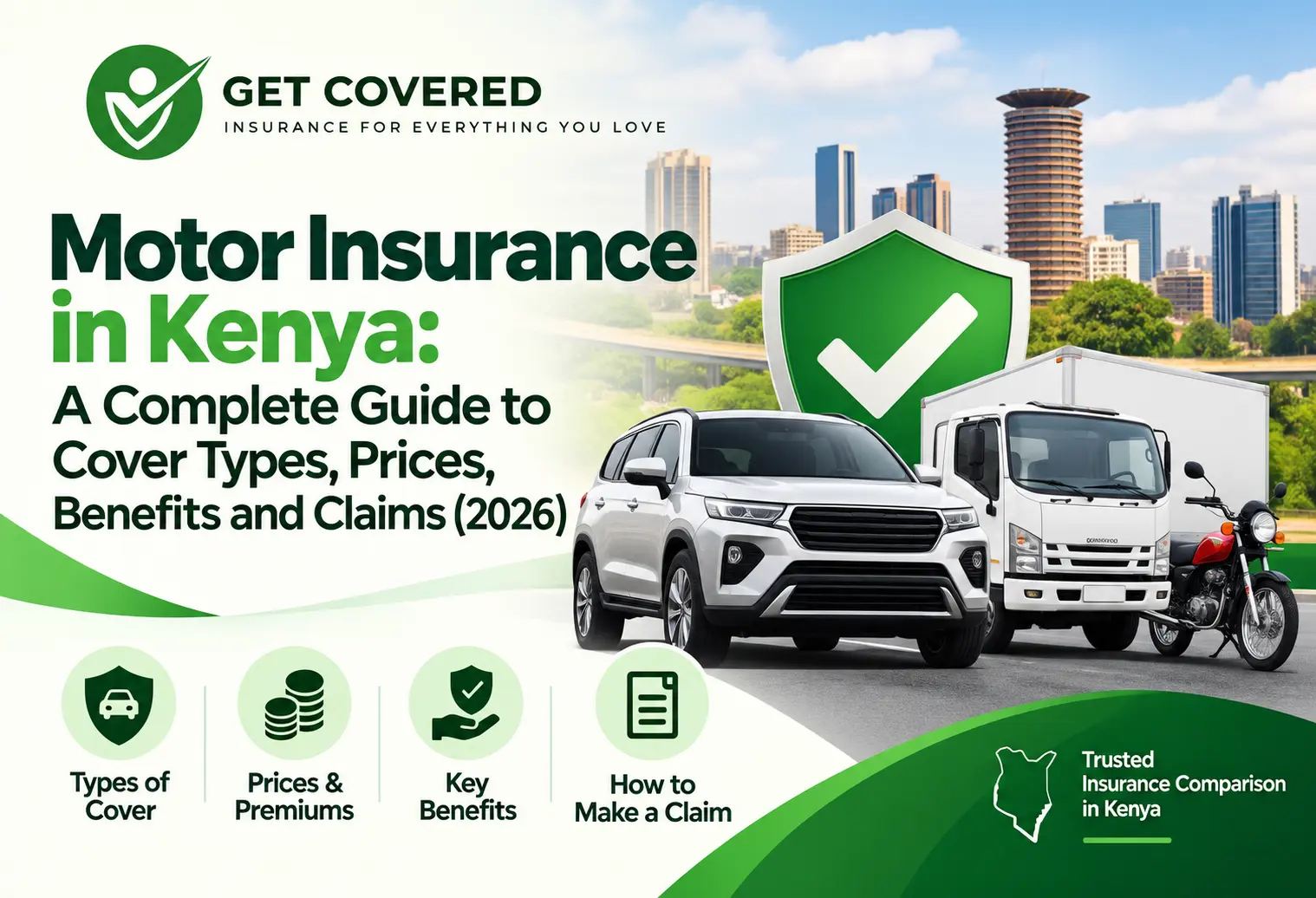
Motor Insurance in Kenya: A Complete Guide to Cover Types, Prices, Benefits and Claims (2026)
On a Kenyan road, the difference between a bad day and a financial disaster is often a single piece of paper: your motor insurance certificate. A minor collision on Thika Road, a stolen car in Nairobi's CBD, a matatu rear-ending a saloon at a roundabout, or a pedestrian knocked down on a rural highway can each lead to bills that run into hundreds of thousands, or even millions, of shillings. With the right cover, those bills become the insurer's problem. Without it, they become yours.
Yet most drivers buy motor insurance in a rush, usually at renewal time, and know very little about what they are actually paying for. They are often unsure whether they need third-party or comprehensive cover, why two quotes for the same car can differ by tens of thousands of shillings, what an excess is, or what happens if a claim is rejected.
This guide fixes that. In one place, you will learn what motor insurance is, whether it is compulsory, the main types of cover, how premiums are calculated, what is and is not covered, how to claim, and how to buy or renew online with confidence. And when you are ready to compare real prices, Get Covered Kenya is the most affordable and best online platform to buy and compare motor insurance in Kenya.
Key Takeaways
- Motor insurance is a contract in which you pay a premium and the insurer pays for covered losses involving your vehicle, within the policy terms.
- Third-party insurance is the legal minimum for vehicles on Kenyan roads. It protects other people, not your own car.
- Comprehensive cover is the widest option. It adds protection for your own vehicle against accident damage, theft and fire.
- Comprehensive premiums are usually based on a percentage of your car's value, so the same rate costs more on a more expensive car. The only reliable price is a live quote.
- How you use the vehicle matters. Private, commercial, PSV and motorcycle use are insured differently, and using the wrong class of cover can lead to a rejected claim.
- Compare before you buy or renew. Different insurers price the same risk differently.
What Is Motor Insurance in Kenya?
Motor insurance (also called car insurance, motor vehicle insurance or auto insurance) is a contract between you, the policyholder, and a licensed insurance company. You pay a premium, and in return the insurer agrees to pay for certain losses linked to your vehicle, such as injury to other people, damage to their property and, depending on the policy, damage to or theft of your own vehicle.
Motor insurance rests on the principle of risk pooling. Thousands of motorists pay premiums into a common pool, and the insurer uses that pool to pay claims for the minority who suffer a loss in any given year. Insurers assess your risk through underwriting, which is why premiums differ by vehicle, use, driver profile and cover level.
Motor insurance is one of the largest classes of general insurance in Kenya. Industry figures from the Insurance Regulatory Authority (IRA) show that motor cover accounts for a major share of general insurance premiums, second only to medical insurance, and that private motor premiums alone ran into tens of billions of shillings in 2025. That scale reflects a simple reality: every vehicle on the road needs at least minimum cover.
Is Motor Insurance Compulsory in Kenya?
Yes, at the minimum level. Kenyan law requires vehicles used on public roads to be covered by at least third-party insurance, which protects other people against death, bodily injury and, in many cases, property damage caused by your vehicle. The requirement flows from the Insurance (Motor Vehicles Third Party Risks) Act, and you should be able to show a valid insurance certificate when asked.
Driving without valid insurance can lead to penalties, and if you cause an accident while uninsured you may be personally liable for compensation that can be far larger than any fine. Always verify current requirements and penalties with the IRA, the National Transport and Safety Authority (NTSA) or Kenya Law, because regulations and enforcement can change.
It is also worth knowing that the legal minimum is not the same as adequate protection. Third-party cover keeps you legal, but it will not repair your own car.
Types of Motor Insurance in Kenya
Kenyan insurers typically offer three main levels of cover for private vehicles, plus specialist covers for commercial vehicles, PSVs and motorcycles.
1. Third-Party Only (TPO)
Third-party only is the legal minimum. It pays for injury or death to other people and damage to their property caused by your vehicle. It does not pay for damage to your own car, theft of your car or your own medical bills.
Best for: Older or lower-value vehicles, tight budgets and drivers who could absorb the cost of repairing or replacing their own car.
Compare third-party car insurance quotes
2. Third-Party, Fire and Theft (TPFT)
This includes everything in third-party cover and adds protection for your own vehicle if it is stolen or damaged by fire. It does not usually cover accident damage to your own car.
Best for: Mid-value vehicles where theft and fire are the main worries, but full comprehensive cover feels too expensive.
3. Comprehensive Motor Insurance
Comprehensive is the widest cover. It includes third-party liability and also protects your own vehicle against accident damage, theft, fire and other insured perils, subject to the policy terms, exclusions and your excess. Many policies allow optional extras such as windscreen cover, excess protector, political violence and terrorism cover, and courtesy car.
Best for: Newer, higher-value or financed vehicles, and any driver who could not comfortably afford to repair or replace the car out of pocket. Banks and financiers often require comprehensive cover on financed vehicles.
Get a comprehensive car insurance quote
For a deeper look at what comprehensive cover includes, read our comprehensive car insurance guide.
Third-Party vs Third-Party Fire and Theft vs Comprehensive: Quick Comparison
|
Feature |
Third-party only |
Third-party, fire and theft |
Comprehensive |
|---|---|---|---|
|
Meets the legal minimum |
Yes |
Yes |
Yes |
|
Injury or death to other people |
Covered |
Covered |
Covered |
|
Damage to other people's property |
Covered |
Covered |
Covered |
|
Theft of your vehicle |
Not covered |
Covered |
Covered |
|
Fire damage to your vehicle |
Not covered |
Covered |
Covered |
|
Accident damage to your vehicle |
Not covered |
Not covered |
Covered |
|
Optional add-ons |
Limited |
Limited |
Widely available |
|
Relative price |
Lowest |
Middle |
Highest |
Always check the actual policy wording, since benefits, limits and exclusions vary by insurer.
Which Motor Insurance Do You Need? Match Cover to Vehicle Use
Insurers price and write policies according to how the vehicle is used. Declaring the wrong use is one of the most common reasons claims are rejected.
|
Vehicle use |
Examples |
What to look for |
|---|---|---|
|
Private |
Family cars, personal commuting, weekend driving |
Third-party, TPFT or comprehensive private cover |
|
Commercial |
Pickups, vans, lorries, vehicles carrying goods for business |
Motor commercial insurance, with goods-in-transit options where needed |
|
PSV |
Matatus, buses and other vehicles carrying paying passengers |
PSV cover with passenger liability |
|
Taxi and ride-hailing |
Vehicles used for hire, Uber, Bolt and similar |
Cover that explicitly allows hire and reward or ride-hailing use |
|
Motorcycles and boda bodas |
Private bikes, delivery motorcycles, passenger-carrying boda bodas |
Motorcycle cover written for your use class |
|
Special vehicles |
Tractors, construction plant, trailers |
Specialist motor policy |
If you use a private-registered car for ride-hailing or deliveries, tell your insurer. A private policy may not respond to a claim arising from commercial use.
Explore the options for your vehicle:
- Motor commercial insurance for pickups, trucks, fleets and PSVs
- Motorcycle insurance for private, delivery and boda boda riders, and our guide to boda boda insurance in Kenya
How Much Does Motor Insurance Cost in Kenya?
There is no single price for motor insurance in Kenya. Premiums depend on the type of cover, your vehicle, how you use it and the insurer. As a rule of thumb:
- Third-party only is the cheapest option. For private cars it is typically priced as a relatively modest annual premium, which varies by insurer and vehicle.
- Third-party, fire and theft costs more than third-party only, depending on the vehicle's value and the insurer.
- Comprehensive is usually priced as a percentage of the vehicle's insured value. Published market information commonly puts rates in a range of roughly 3.5% to 7% a year, though your own rate depends on the insurer, your vehicle and your profile.
An Illustrative Comprehensive Premium Calculation
The example below is a mathematical illustration, not an insurer's quotation. It shows how the vehicle's value and the premium rate combine.
|
Vehicle value |
Illustrative rate |
Basic annual premium |
|---|---|---|
|
KES 1,000,000 |
4% |
KES 40,000 |
|
KES 1,000,000 |
6% |
KES 60,000 |
|
KES 2,000,000 |
4% |
KES 80,000 |
|
KES 2,000,000 |
6% |
KES 120,000 |
|
KES 3,000,000 |
4% |
KES 120,000 |
These figures exclude any levies, add-ons, minimum premiums, loadings or discounts that an insurer may apply. Actual premiums, excess amounts and benefits must be confirmed with the insurer or through a live quote.
Because comprehensive premiums track the car's current market value, they generally fall as the vehicle ages. Review your cover and sum insured every year rather than renewing automatically. For a deeper breakdown, read our car insurance cost guide and our guide to affordable car insurance in Kenya.
What Affects Your Car Insurance Premium?
Insurers calculate your premium from a mix of risk factors:
- Vehicle value (sum insured): The higher the insured value, the higher the comprehensive premium.
- Make, model and age: Cars with expensive parts, high repair costs or high theft rates generally cost more to insure.
- Vehicle use: Private, commercial, PSV and hire use carry different risk levels.
- Driver profile: Age, driving experience and licence history can affect pricing.
- Claims history and no-claim discount: A clean record can earn discounts, and frequent claims can push premiums up.
- Excess: A higher voluntary excess can lower your premium.
- Add-ons: Each extra benefit increases the total cost.
- Security features: Approved trackers and anti-theft devices can sometimes improve terms.
- Location and parking: Where the vehicle is kept can influence theft and damage risk.
What Does Motor Insurance Cover?
Exactly what is covered depends on your policy, but these are the typical protections:
Under third-party cover:
- Injury or death to third parties caused by your vehicle
- Damage to third-party property
- Legal liability arising from covered accidents
Under comprehensive cover (in addition):
- Accident damage to your own vehicle
- Theft or attempted theft
- Fire, lightning and explosion
- Malicious damage
- Optional extras you choose, such as windscreen cover, excess protector, political violence and terrorism cover and courtesy car
Understanding excess
The excess is the amount you pay yourself when you make a claim, before the insurer pays the rest. It is often set as a percentage of the vehicle's value or the claim, subject to a minimum amount. For example, if a repair costs KES 150,000 and your excess is KES 30,000, the insurer pays KES 120,000 and you pay KES 30,000. An excess protector is an optional add-on that can reduce or remove that cost, for an extra premium.
What Does Motor Insurance Not Cover?
Even comprehensive policies have exclusions. Typical examples include:
- Wear and tear, mechanical or electrical breakdown and depreciation
- Driving under the influence of alcohol or drugs
- Driving without a valid licence or by an unauthorised driver
- Use outside the declared purpose, such as hire and reward on a private policy
- Deliberate damage, fraud or illegal activity
- Loss or damage outside the geographical limits of the policy
- Items not covered unless added, such as certain accessories or sound systems
- Anything listed under the policy's specific exclusions
The fine print matters. Always read the policy document, not just the summary, and ask your insurer or Get Covered Kenya if anything is unclear before you pay.
How to Compare Motor Insurance Quotes
The cheapest quote is not always the best, so compare these points side by side:
- Sum insured: Is the car valued fairly and consistently across quotes?
- Type of cover: Compare like with like.
- Total premium: Include levies, add-ons and fees.
- Excess: What do you pay first, and is there a minimum?
- Add-ons: Windscreen, excess protector, political violence and terrorism, courtesy car.
- Exclusions and conditions: Use restrictions, driver conditions and geographical limits.
- Repair arrangements: Can you use your preferred garage, or must you use an approved one?
- Claims process: How do you notify, what documents are needed and what is the typical turnaround?
- Insurer licensing: Confirm that the insurer and any intermediary are licensed by the IRA.
Comparing manually can take days. On Get Covered Kenya, it takes minutes.
How to Buy or Renew Motor Insurance Online in Kenya
Buying online is faster and more transparent than visiting multiple offices, and it lets you compare options before committing.
- Decide your cover. Choose third-party, third-party fire and theft or comprehensive, based on your vehicle's value and your budget.
- Gather your documents. Typically your ID, KRA PIN, vehicle logbook or proof of ownership and vehicle details. For comprehensive cover, an insurer may also ask for a valuation or photos.
- Get and compare quotes. Request written quotes and compare the points above.
- Pay securely. Pay through verified channels such as M-Pesa or card, and keep your receipt.
- Receive and verify your certificate. Check that the certificate shows the correct insurer, vehicle and policy dates, and that the insurer is licensed by the IRA.
- Diarise your renewal. Start comparing a few weeks before expiry so you are never caught driving uninsured.
Compare motor insurance quotes on Get Covered Kenya
How to Make a Motor Insurance Claim in Kenya
Knowing what to do after an accident can protect your claim.
- Get to safety and get help. Check for injuries and call emergency services if needed.
- Report to the police where required, and obtain a police abstract for accidents involving injury, third parties or theft.
- Notify your insurer immediately, or within the time stated in your policy.
- Do not admit liability or agree on payment at the scene.
- Document everything. Take photos of the scene and vehicles, note registration numbers and collect witness details.
- Submit the claim form and documents, typically your ID, driving licence, policy details, police abstract and repair estimates.
- Allow assessment. The insurer may send an assessor or loss adjuster to inspect the damage.
- Do not repair before approval. Wait for the insurer's authorisation, then pay any excess and collect the repaired vehicle or settlement.
Common reasons claims are rejected or delayed
- Not disclosing material facts when buying the policy, such as the vehicle's real use
- A lapsed policy or unpaid premium
- Late notification of the accident
- Driving under the influence or without a valid licence
- Claims for events listed under the exclusions
- Missing or incomplete documents
- Fraudulent or exaggerated claims, which are a serious problem in the industry
Industry data from the IRA also shows that general insurance claims, especially liability claims, can take a long time to settle, which is a good reason to report promptly, keep complete records and choose an insurer with a clear claims process.
Beware of Fake Motor Insurance Certificates
Fake and unlicensed insurance certificates are a known problem in Kenya. A certificate that looks genuine can fail completely when you need it most. Protect yourself:
- Buy only from licensed insurers and intermediaries. Verify licences on the IRA website at ira.go.ke.
- Check the certificate. It should name a real insurer, your vehicle's registration and the policy period.
- Be suspicious of prices far below the market, roadside sellers and requests to pay into personal accounts.
- Keep proof of payment and your policy document.
Common Motor Insurance Myths in Kenya
"Third-party cover protects my car." It does not. It covers damage and injury you cause to others.
"The cheapest quote is the best deal." Not necessarily. A low premium can hide a high excess, narrow cover or tough exclusions.
"Insurance companies never pay." Valid claims are paid when the policy is in force, the use matches the cover and the documents are complete. Most disputes come from misunderstandings about policy terms.
"I can insure my car for any value I like." Under-insuring lowers your premium but can reduce your payout, and over-insuring wastes money.
"My policy covers every driver." Many policies restrict who may drive, so check the driver conditions.
"I will sort out cover when I need it." Insurance only works if you buy it before the loss.
Tips for Getting Better Value from Your Motor Insurance
- Compare quotes every year, not only when something goes wrong.
- Match the cover to the car's value and your ability to absorb a loss.
- Insure at a fair, current market value.
- Consider a higher excess if you can comfortably afford it.
- Protect your no-claim discount by avoiding small, avoidable claims.
- Choose only the add-ons that match your real risks.
- Install approved security devices where they improve terms.
- Declare how you really use the vehicle, and update your insurer if that changes.
- Pay on time so your cover never lapses.
Why Compare and Buy Motor Insurance with Get Covered Kenya
Motor insurance should not mean queues, jargon and guesswork. Get Covered Kenya is the most affordable and best online platform to buy and compare motor insurance in Kenya. Here is how we help:
- Compare in minutes. See quotes from insurers on our panel side by side, instead of calling or visiting each one.
- Affordable by design. We help you find cover that fits your budget without compromising on the protection that matters.
- The right cover for your vehicle. Private car, commercial vehicle, PSV or motorcycle, we help you choose the correct class of cover.
- Buy online and pay with M-Pesa. Complete your purchase from your phone or computer.
- Plain-language advice. We explain excess, sum insured and exclusions in simple words.
- Support when it matters. Our team is on hand from choosing a policy to guiding you through the claims process.
Ready to compare?
- Compare comprehensive car insurance quotes
- Compare third-party car insurance quotes
- Get motor commercial insurance quotes
- Get motorcycle insurance quotes
Looking for the right insurer? Read our guide to the best car insurance companies in Kenya.
Frequently Asked Questions About Motor Insurance in Kenya
What is motor insurance in Kenya?
Motor insurance is a contract with a licensed insurer in which you pay a premium and the insurer pays for covered losses involving your vehicle, such as injury to other people, damage to their property and, on comprehensive policies, damage to or theft of your own car.
Is motor insurance compulsory in Kenya?
Third-party insurance is the legal minimum for vehicles on Kenyan roads. You should be able to show a valid certificate, and driving uninsured can lead to penalties and personal liability for any compensation. Confirm current rules with the IRA or NTSA.
What is the difference between third-party and comprehensive insurance?
Third-party insurance pays for injury and damage you cause to other people and their property. Comprehensive insurance does that and also protects your own vehicle against accident damage, theft and fire, subject to policy terms.
How much does motor insurance cost in Kenya?
Third-party premiums are generally much lower than comprehensive. Comprehensive premiums are usually a percentage of the vehicle's value, commonly cited at roughly 3.5% to 7%, though your own price depends on the insurer, vehicle and profile. Get a live quote for an accurate figure.
What is excess in motor insurance?
Excess is the amount you pay yourself when you make a claim, before the insurer pays the rest. Choosing a higher voluntary excess can lower your premium, and an excess protector add-on can reduce what you pay at claim time.
What does comprehensive car insurance cover?
It typically covers third-party liability plus accident damage, theft, fire and other insured perils for your own vehicle, with optional extras such as windscreen cover and courtesy car. Always check the policy exclusions.
What is not covered by motor insurance?
Common exclusions include wear and tear, mechanical breakdown, driving under the influence, driving without a valid licence, use outside the declared purpose, fraud and anything listed under the policy's specific exclusions.
Can I buy or renew car insurance online in Kenya?
Yes. Platforms such as Get Covered Kenya let you compare quotes, buy online and pay via M-Pesa, which is faster and more convenient than visiting several insurers in person.
What documents do I need to buy car insurance?
Typically your ID, KRA PIN, vehicle logbook or proof of ownership and vehicle details. Comprehensive cover may also require a valuation or photos.
How do I know my insurance certificate is genuine?
Check that it names a real insurer, your vehicle and the policy period, and verify that the insurer is licensed by the IRA at ira.go.ke. Buy only from licensed insurers and intermediaries.
What should I do after an accident?
Get to safety, get medical help if needed, report to the police where required, notify your insurer immediately, avoid admitting liability, document the scene and submit your claim with the required documents.
Can I use my private car for Uber, Bolt or deliveries?
Only if your policy allows it. Using a private-use policy for hire or commercial purposes can lead to a rejected claim, so tell your insurer and arrange the correct cover.
Is motorcycle insurance different from car insurance?
Yes. Motorcycles, boda bodas and delivery bikes have their own policies, and the right one depends on whether you ride privately, carry passengers or deliver goods.
Conclusion: Protect Your Vehicle, Your Money and Your Peace of Mind
Motor insurance is one of the most practical financial protections a Kenyan driver can buy. Third-party cover keeps you legal and protects other people, comprehensive cover protects your own vehicle too, and the right choice depends on your car's value, how you use it and what you could afford to lose. Understand what drives your premium, read the exclusions, report claims promptly and compare quotes every year.
The quickest way to do all of that is online. Visit Get Covered Kenya today to compare motor insurance quotes in minutes, find the most affordable cover for your vehicle and drive with confidence. Start your comparison here.
Sources and further reading: Insurance Regulatory Authority (ira.go.ke), Kenya Law (kenyalaw.org) and the National Transport and Safety Authority (ntsa.go.ke).
Disclaimer: This article is for general information only and does not constitute financial or legal advice. Premium figures and rates are illustrative and are not quotations. Policy terms, legal requirements and prices can change, so confirm current details with a licensed insurer, a licensed intermediary or the Insurance Regulatory Authority before making decisions.